Proudly serving Tucson, Oro Valley, Marana, Vail, Sahuarita, Green Valley & surrounding areasCall or Text 24/7: +1 (520) 567-9887

Tucson Epoxy Co. - Garage Floor Epoxy, Concrete Floor Coatings, Polyaspartic Floor Coatings in Tucson, AZ

Tucson Epoxy Co. installs garage floor epoxy, concrete floor coatings, and polyaspartic floor coatings for homes and businesses in Tucson, AZ. We also provide commercial and industrial epoxy flooring, flake and metallic finishes, patio and pool deck coatings, and concrete repair and resurfacing. Each system is chosen for the slab's traffic, sun exposure, and condition rather than treated like a simple paint job. Our service area includes communities across Pima County.

Tucson concrete can face exposed slab temperatures above 140 degrees, UV index readings that regularly exceed 10, and caliche-heavy soil movement during monsoon season. Our crews mechanically diamond-grind or shot-blast surfaces to an ICRI CSP-3 profile, test moisture when slab-on-grade conditions warrant it, and repair cracks before coating. We follow ICRI surface preparation standards and use ASTM D4541 pull-off adhesion testing to confirm bond strength. That preparation helps reduce peeling, hot-tire pickup, moisture trouble, and premature coating failure.

Tucson Epoxy Co. is a licensed epoxy contractor with an active Arizona Registrar of Contractors license and full general liability insurance on every crew. Our installers have coated garage floors in Oro Valley, warehouse floors in South Tucson's industrial corridor, and pool decks in the Catalina Foothills.

★ ★ ★ ★ ★4.9/5 Average Rating · 20+ Years of Experience · Thousands of Customers Helped · Licensed & Insured · Residential & Commercial

Locally Trusted

Written Slab Quotes
ICRI CSP-3 Preparation
ASTM D4541 Adhesion Testing
Tucson & Pima County
Core Coating Services

Epoxy Flooring Services

We match each coating build to vehicle traffic, foot traffic, chemicals, sunlight, moisture, texture, and design goals. Our services span residential garages and patios through retail, office, warehouse, and manufacturing floors.

Garage Floor Epoxy

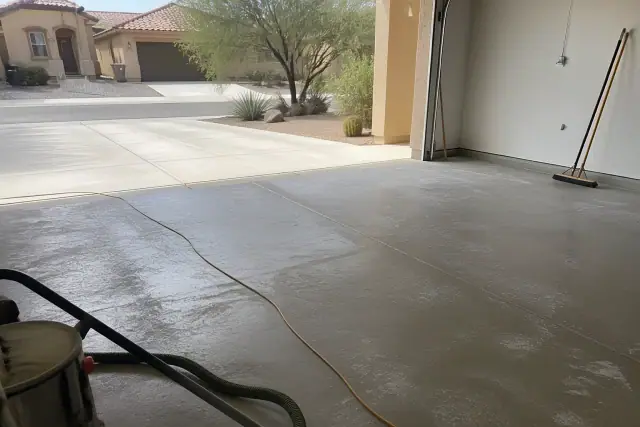
Empty residential garage with a prepared concrete floor in Tucson, AZ, viewed from the street.

Garage systems are built around daily parking, workshops, or home gyms, with crack repair, primer, color, optional decorative flake, and an abrasion- and stain-resistant topcoat. A properly installed system resists hot-tire pickup, gasoline, brake fluid, and tracked de-icing salt residue, and can outlast a paint-and-seal job by a decade or more.

Explore Service
Concrete Floor Coatings

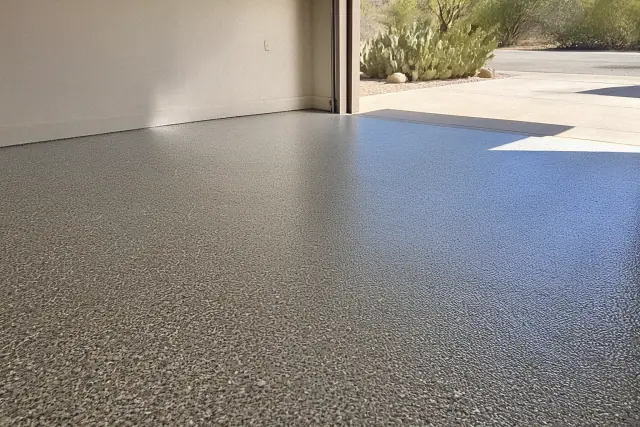
Concrete garage floor with a decorative flake finish in a residential garage in Tucson, AZ.

Concrete floor coatings seal porous slabs against moisture and staining while adding a finish selected for the floor's traffic and exposure. Mechanical preparation opens the concrete pore structure before the coating build begins.

Explore Service

Polyaspartic Floor Coatings

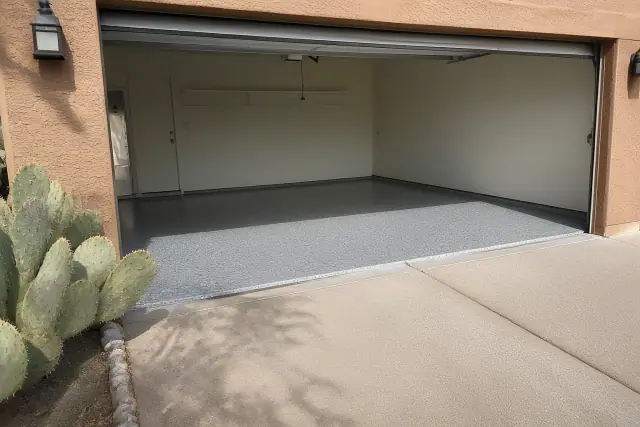
Concrete garage floor with decorative flakes and a prickly pear cactus outside a home in Tucson, AZ.

Polyaspartic coatings reach a walkable state in hours rather than days and resist UV yellowing better than standard epoxy topcoats. Their wider application-temperature range and fast cure suit Tucson garages and patios when turnaround and sunlight exposure matter.

Explore Service

Commercial Epoxy Flooring

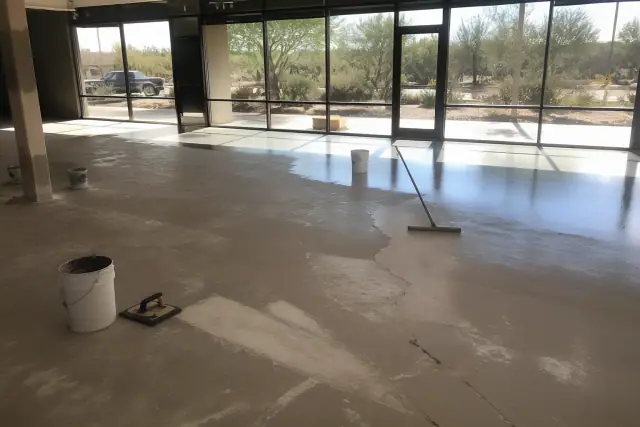
Concrete floor prepared for epoxy installation inside a retail showroom in Tucson, AZ with mixing buckets and tools.

Commercial systems handle foot traffic, rolling carts, and daily cleaning in retail spaces, offices, lobbies, break rooms, and corridors. Low-VOC options, custom colors, night or weekend scheduling, and phased installation help reduce disruption in occupied facilities.

Industrial Epoxy Flooring

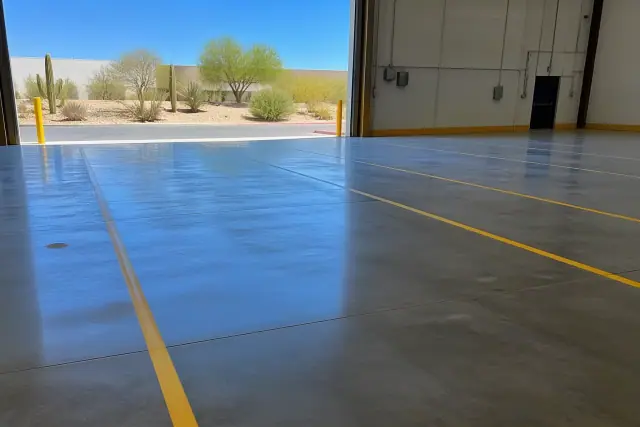
Industrial warehouse concrete floor with safety zones prepared for epoxy coating in Tucson, AZ.

Trowel-applied epoxy mortar and self-leveling builds are specified for forklift traffic, pallet jacks, dropped tools, and continuous abrasion. Where solvents, acids, or petroleum products are present, resin chemistry may call for a chemical-resistant epoxy or novolac topcoat.

Flake Epoxy Flooring

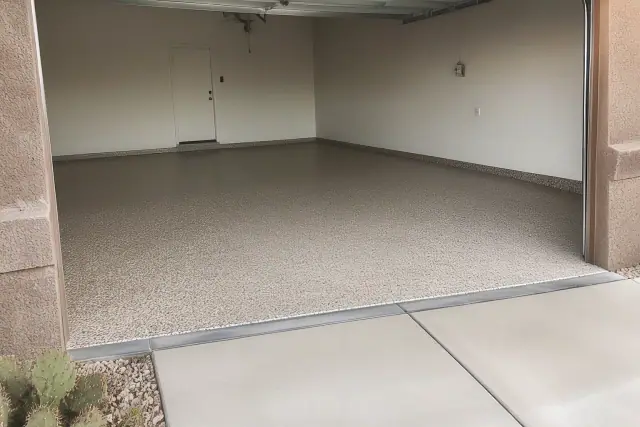
Completed flake epoxy garage floor in a Tucson, AZ home with southwestern architecture and prickly pear cacti.

Colored vinyl chips broadcast into a wet epoxy base create a durable, speckled finish that hides dust, tire marks, and minor surface debris. Full-broadcast systems can also be ground and polished for a terrazzo-style look while adding useful texture underfoot.

Metallic Epoxy Flooring

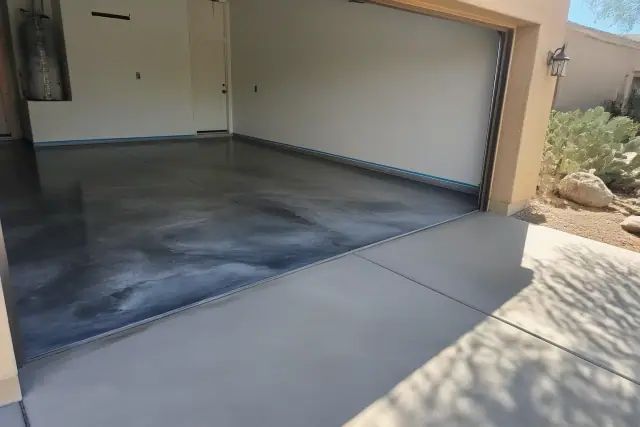
Metallic epoxy garage floor with a marbleized resin finish in a residential home in Tucson, AZ.

Mica-based metallic pigments are manipulated in clear or tinted epoxy to form three-dimensional marbled patterns. Multiple colors, targeted heat, and controlled airflow can create lacing, cell, and crater effects for custom homes, showrooms, and tasting rooms.

Patio Floor Coatings

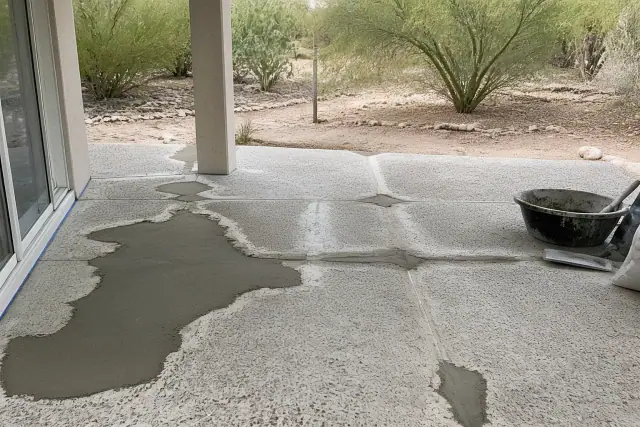
Concrete patio undergoing repair and surface leveling in a Tucson, AZ backyard with desert landscaping.

UV-resistant epoxy and polyaspartic patio systems are selected to resist chalking, cracking, and moisture intrusion under Tucson sun and monsoon downpours. Color and texture options can also stay cooler underfoot than bare concrete or dark pavers.

Pool Deck Coatings

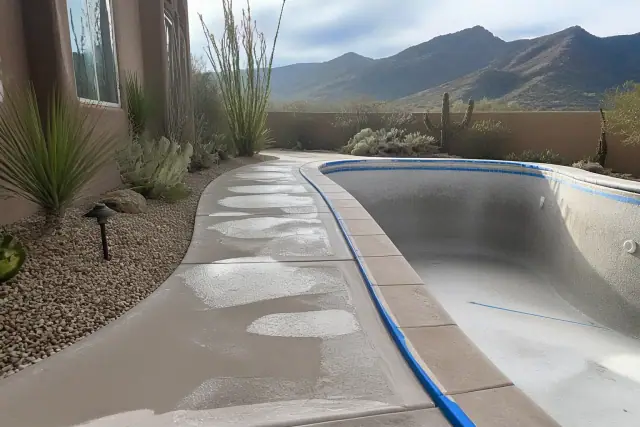
Concrete pool deck awaiting sealant application with a desert mountain backdrop in Tucson, AZ.

Slip-resistant aggregate adds traction around wet pool areas, while the coating build resists chlorine, salt-system byproducts, and sunscreen oils that can break down standard sealers within a season or two. Surrounding walkways and pool aprons can be coated for one coordinated surface.

Concrete Repair & Resurfacing

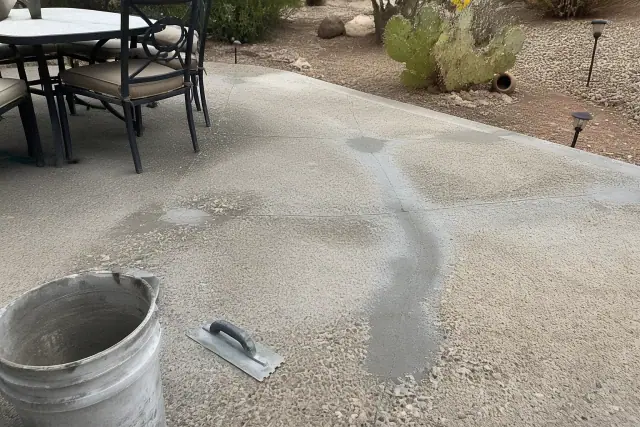
Concrete patio undergoing structural repair and surface leveling in a Tucson, AZ backyard.

Cracked, spalled, or pitted slabs can often be resurfaced instead of demolished. Semi-rigid epoxy crack fillers, polymer-modified overlays, and whole-slab grinding create a more uniform profile before the finish system is installed.

Specialized Coating Systems

Systems for Demanding Tucson Spaces

Some floors need more than a standard color coat. These systems address heavy point loads, decorative goals, direct sun, chemical exposure, wet conditions, and damaged concrete with a build selected for the actual use of the slab.

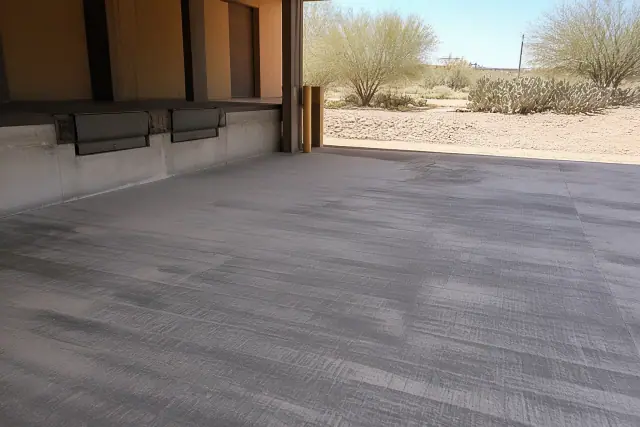
Concrete floor prepared for coating at a warehouse loading dock in Tucson, AZ with desert landscape in the background.

Commercial & Industrial Floor Builds

Floor thickness, resin chemistry, texture, and scheduling are matched to the facility's traffic and operating conditions. Retail, office, warehouse, manufacturing, and processing spaces each receive a different specification.

  • Retail floors for foot traffic, rolling carts, and cleaning chemicals
  • Low-VOC office systems in neutral or custom colors
  • Warehouse broadcast or trowel builds that may exceed 30 mils
  • Systems for forklifts, pallet jacks, and heavy point loads
  • Night, weekend, or phased installation around operations
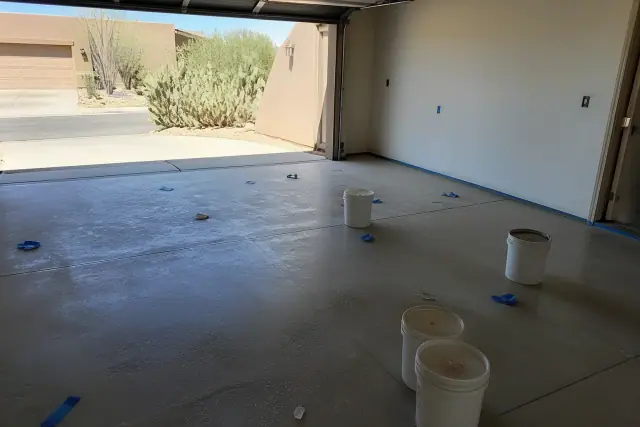
Empty two-car garage prepped for epoxy floor coating with mixing buckets and cacti visible in Tucson, AZ.

Decorative Flake & Metallic Finishes

Decorative systems add character without giving up a protective coating build. Flake offers texture and visual camouflage, while metallic pigments create a one-of-a-kind marbled floor.

  • Mica-based pigments suspended in clear or tinted epoxy
  • Custom metallic color combinations
  • Lacing, cell, and crater effects shaped with heat and airflow
  • Colored vinyl-chip blends that hide dust and tire marks
  • Full-broadcast flake finished in a terrazzo style
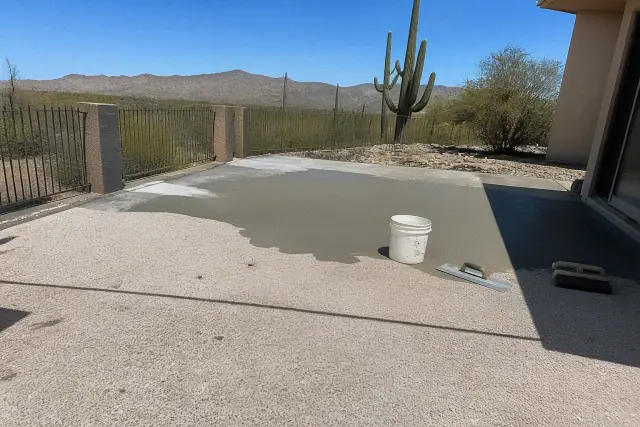
Concrete backyard patio undergoing surface leveling and repair in Tucson, AZ with saguaro cacti in the distance.

UV-Resistant Outdoor Coating Systems

Tucson patios can face direct sun for eight or more months a year, sudden July and August monsoon downpours, slab temperatures well above 120 degrees, and occasional winter frost in the foothills. Outdoor systems pair exposure-appropriate coatings with texture and color choices that ordinary paint may not survive for even one or two seasons.

  • UV-resistant topcoats that help limit yellowing and chalking
  • Fast-curing polyaspartic options for patios and garages
  • Slip-resistant aggregate for pool decks and wet entries
  • Resistance to chlorine, salt byproducts, and sunscreen oils
  • Color and texture choices designed for outdoor comfort
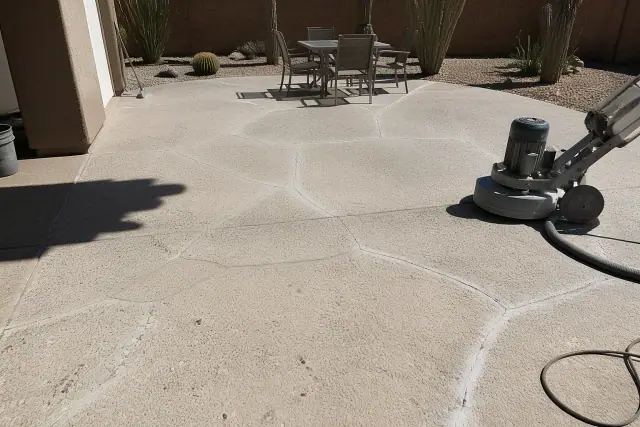
Concrete repair and surface preparation on a backyard patio in Tucson, AZ, featuring a floor grinder and crack filler.

Concrete Repair & Surface Preparation

Roughly a third of premature coating failures we are called to inspect trace back to inadequate surface preparation or moisture issues. Careful repair and profiling can be the difference between failure within a year and a coating that holds for two decades.

  • Assessment of cracks, spalls, pits, and old coatings
  • Semi-rigid epoxy crack filler
  • Polymer-modified overlays for spalled sections
  • Diamond grinding or shot-blasting for a uniform profile
  • Moisture testing and mitigation planning when needed
Built for Desert Concrete

Why Choose Tucson Epoxy Co.

A coating is only as reliable as the slab evaluation, preparation, and resin selection beneath it. Our approach accounts for Tucson heat, intense UV, monsoon moisture, soil movement, traffic, chemicals, and the way each property uses the finished floor.

Desert-Specific Coating Design

We select coating builds for Sonoran Desert conditions instead of copying specifications from wetter, cooler climates. Caliche-heavy soil movement, thermal cycling, and intense UV exposure all influence the preparation and topcoat chosen for a Tucson slab.

Measured Surface Preparation

Mechanical grinding or shot-blasting creates an ICRI CSP-3 profile, with moisture testing used where slab-on-grade conditions warrant it. ASTM D4541 pull-off adhesion testing provides a measurable check on bond strength before coating proceeds.

Licensed & Insured Crews

Tucson Epoxy Co. holds an active Arizona Registrar of Contractors license and sends crews covered by full general liability insurance. Experience across Oro Valley garages, South Tucson warehouses, and Catalina Foothills pool decks informs how we adjust for exposure and property use.

Signs Your Slab Needs Attention

Common Concrete Coating Problems

Cracks, stains, dusting, moisture, fading, and slippery surfaces point to different slab or coating conditions. An assessment helps separate cosmetic wear from preparation, exposure, or resin-selection problems before a new system is specified.

Request an Assessment

Cracks, Spalling & Pitting

Caliche-heavy soil movement and thermal cycling can leave Tucson slabs cracked, spalled, or pitted. These defects need repair and a uniform surface profile before coating so weak areas do not telegraph through the finish.

Hot-Tire Pickup & Stains

Hot tires can lift weak paint or poorly bonded coatings, while oil, gasoline, and brake fluid leave garage slabs difficult to clean. Abrasion- and stain-resistant topcoats are selected for standard passenger-vehicle traffic after the slab is properly prepared.

UV Yellowing & Chalking

Standard epoxy can yellow or chalk under prolonged direct sunlight. Patios, pool decks, garages with strong sun exposure, and floors below windows or skylights need a UV-resistant finish such as an exposure-appropriate polyaspartic topcoat.

Moisture Vapor & Blistering

Moisture vapor transmission from below a slab can contribute to bubbles, blisters, or delamination when it is ignored. Testing is used where slab-on-grade conditions warrant it so moisture mitigation can be included before the coating build.

Dusty, Porous Concrete

Bare concrete can turn gray and dusty while absorbing oil, moisture, and stains from mineral-heavy tap water. Grinding opens the pore structure for bonding, and the finished coating seals the surface for easier upkeep.

Slippery Wet Surfaces

A smooth coating can become slippery when wet if texture is not planned into the system. Slip-resistant aggregate adds traction to pool decks, patios, commercial entries, and industrial process areas exposed to water or oil.

How It Works

Our Epoxy Floor Installation Process

A durable floor starts with learning how the slab is used and what it has been exposed to. From inspection through cure guidance, each step is selected to create a clean bond and a coating build appropriate for the traffic, chemicals, sunlight, and moisture involved.

01.

Walk the Slab

We inspect the surface for cracks, spalls, pits, old sealers, stains, and signs of moisture, then discuss traffic, exposure, and finish goals. The written quote reflects the slab's actual condition instead of a sight-unseen flat rate.

02.

Test and Specify

Moisture testing is added where slab-on-grade conditions warrant it, and resin chemistry is selected for the traffic, UV, temperature, and chemicals present. The plan also sets texture, color, coating thickness, and cure requirements.

03.

Mechanically Prepare

Diamond grinding or shot-blasting removes weak surface material and opens the concrete pore structure. Preparation continues to an ICRI CSP-3 profile rather than stopping at a broom-clean surface.

04.

Repair Cracks and Spalls

Semi-rigid epoxy filler is worked into cracks, and polymer-modified overlays rebuild spalled sections. Repairs and the surrounding slab are ground to a consistent profile before primer or base coat application.

05.

Build the Coating System

The specified primer and color base are applied, followed by an optional flake broadcast or metallic treatment. An epoxy, polyaspartic, or chemical-resistant topcoat completes the build according to the space's use.

06.

Follow the Cure Schedule

At the end of installation, we provide a specific schedule for walking, moving equipment, and parking on the new floor. Cure time depends on whether the system uses standard epoxy or faster-curing polyaspartic materials.

Epoxy Flooring Service Areas

Tucson Epoxy Co. serves homeowners and businesses across Pima County, with systems adjusted for property use, elevation, soil conditions, and sun exposure. Our project experience ranges from residential garages and pool decks to retail, office, warehouse, and manufacturing floors.

  • Tucson Homes
  • Tucson Businesses
  • Oro Valley Garages
  • South Tucson Industrial Corridor
  • Sahuarita Homes
  • Dove Mountain Homes
  • Midtown Tucson Garages
  • Broadway Boulevard Storefronts
  • Tucson Shopping Corridors
  • Tucson International Airport Industrial Park
  • Tucson Metro Industrial Parks
  • Catalina Foothills Custom Homes
  • Catalina Foothills Pool Decks
  • Marana Pool Areas
  • Green Valley Pool Areas
  • West Tucson Properties
  • East Tucson Properties
  • Tucson Foothills
  • Pima County
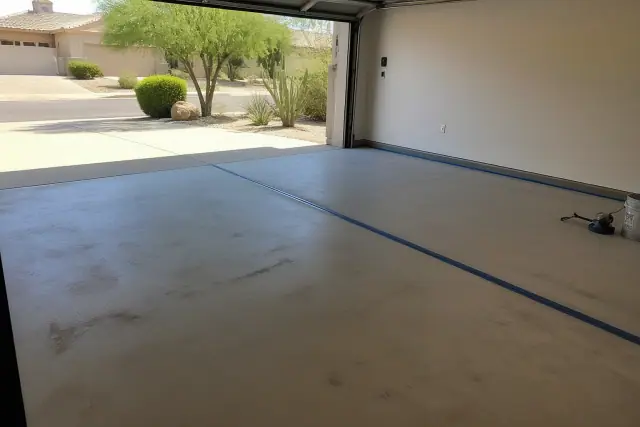
An empty two-car residential garage floor prepped for epoxy in Tucson, AZ with desert landscaping visible outside.

Honest Feedback from Tucson Customers

Customer Experiences
★ ★ ★ ★ ★

Our garage floor had old oil stains and hot-tire marks. The crew explained the crack repair and flake options clearly, and the finished surface is much easier to keep clean.

AL
Amanda L.Sahuarita Homeowner
★ ★ ★ ★ ★

We needed a warehouse floor that could take pallet jacks without shutting down the whole operation. The work was sequenced around our schedule, and the new surface feels solid under daily traffic.

JR
Jason R.South Tucson Facility Manager
★ ★ ★ ★ ★

Our pool deck was faded and slick whenever it got wet. The texture recommendation made sense for bare feet, and the coordinated coating around the walkways gave the whole area a cleaner look.

PS
Priya S.Catalina Foothills Homeowner
★ ★ ★ ★ ★

The slab in our older garage was cracked, pitted, and constantly dusty. They showed us where resurfacing was needed before coating, and the finished floor now looks even and is far simpler to maintain.

MT
Michael T.Midtown Tucson Homeowner
Request a Slab Assessment

Plan Your Epoxy
Flooring
Project

Tell us how the space is used, the surface condition, and your preferred finish. We will inspect the slab and prepare a written quote based on the actual preparation and coating build it needs.

Tucson Epoxy Flooring Help

Tucson Epoxy Flooring Questions, Answered

Costs, cure times, surface condition, traffic, sunlight, and the selected finish all shape an epoxy flooring project. These answers cover common planning questions for Tucson garages, patios, pool decks, and commercial or industrial floors.

Call Our Team

Most Tucson projects for a 1,000-square-foot area fall between $3,000 and $9,000. Standard two-coat epoxy is generally at the lower end, while polyaspartic, metallic, and full-broadcast flake systems trend higher; crack repair, grinding, and moisture mitigation can also change the written quote.

A gallon of professional-grade epoxy resin typically costs $40 to $100 depending on the formulation. Pigmented kits and metallic systems cost more than clear or standard-color products, while contractors purchasing commercial-grade material in bulk may pay less per gallon than small retail-kit pricing.

A 20x20 garage is 400 square feet and typically falls between $1,500 and $3,600 installed. The coating system and the amount of crack repair, stain removal, or grinding required determine where the project lands in that range.

A roughly 250-square-foot single-car garage or small patio generally ranges from about $900 to $2,300 installed. Coating type, decorative flake or metallic upgrades, and existing slab condition drive the variation.

Light foot traffic is usually possible on standard epoxy after 24 hours, but vehicle traffic often requires a full cure of 5 to 7 days. Polyaspartic coatings can often accept foot traffic within hours and vehicle traffic within 24 to 72 hours; every client receives the cure schedule for the installed system.

Standard epoxy can yellow or chalk under prolonged direct UV exposure, and a smooth finish can be slippery when wet without aggregate. Epoxy also depends on thorough grinding and correct mixing; skipped preparation or rushed mixing can lead to peeling, bubbling, or weak adhesion.

With proper surface preparation and a UV-stable topcoat, a concrete coating system typically lasts 10 to 20 years indoors. UV-exposed outdoor applications typically last 8 to 15 years, depending on traffic and maintenance.

Epoxy provides a versatile base for standard color, flake, metallic, self-leveling, and mortar systems. Polyaspartic material cures faster, works across a wider temperature range, and resists UV yellowing better, making it useful for fast-turnaround garages and sun-exposed patios.

Mechanical grinding or shot-blasting opens the concrete pore structure and creates the ICRI CSP-3 profile used for bonding. Moisture testing and ASTM D4541 adhesion testing help identify conditions that can cause delamination; roughly a third of premature failures we inspect trace back to inadequate preparation or unaddressed moisture.

A typical garage installation follows a two-day process, with grinding and crack repair on day one, then primer, color, optional flake, and topcoat. One-day installation options may be available for smaller garages when slab conditions allow.

Warehouse and manufacturing floors may need thicker broadcast, trowel-applied epoxy mortar, or self-leveling systems for forklift traffic, pallet jacks, and point loads. Some warehouse builds exceed 30 mils, while chemical exposure may require a resin or novolac topcoat selected for the solvents, acids, or petroleum products present.

Yes. Slip-resistant aggregate can be broadcast into the pool deck coating to add texture for wet feet, and the coating system can be selected to resist chlorine, salt-system byproducts, and sunscreen oils.

Often, yes. Semi-rigid epoxy filler can address cracks, polymer-modified overlays can rebuild spalled sections, and whole-slab grinding can create a uniform profile before coating, avoiding demolition when the slab is suitable for resurfacing.

Flake systems use colored vinyl chips for a speckled, textured finish that hides dust and tire marks, and full-broadcast flake can be polished for a terrazzo-style look. Metallic systems suspend mica-based pigments in epoxy and use color layering, heat, and airflow to create marbled lacing, cell, and crater effects.