Proudly serving Tucson, Oro Valley, Marana, Vail, Sahuarita, Green Valley & surrounding areasCall or Text 24/7: +1 (520) 567-9887

Pool Deck Coatings, Concrete Resurfacing, and Non-Skid Finish Installation in Tucson, AZ

Tucson Epoxy Co. provides pool deck coatings and concrete resurfacing for homes and commercial properties in Tucson, Arizona. We install epoxy, polyaspartic, acrylic cool-deck, flake, metallic, and textured non-skid finishes. Our work can include mechanical slab preparation, crack repair, and bonded overlays when the existing concrete is structurally sound. Each recommendation is based on slab condition, sun exposure, drainage, and how the pool area is used.

Tucson receives more than 350 days of sunshine a year, while monsoon downpours, chlorine splash-out, and wide temperature swings add stress to exposed concrete. Bare decks can become hot, cracked, pitted, slick, or faded as the surface breaks down. We mechanically profile concrete to ICRI CSP standards and use ASTM slip-resistance testing methods to evaluate traction. That preparation helps the selected coating perform under direct sun, wet feet, and pool chemicals.

Our crews use low-VOC coating systems that meet Arizona Department of Environmental Quality guidance, and the company carries Arizona Registrar of Contractors credentials. Every free estimate includes a moisture test, crack survey, and slope check so the written recommendation reflects the deck in front of us.

Tucson Epoxy Co. provides pool deck coatings throughout Tucson and nearby Oro Valley, Marana, Sahuarita, and Vail.

★ ★ ★ ★ ★4.9/5 Average Rating · 20+ Years of Experience · Thousands of Customers Helped · Licensed & Insured · Residential & Commercial

Pool Deck Coating Options and Benefits

What Are Pool Deck Coatings?

A pool deck coating is a layered finish applied over properly prepared concrete to improve traction, appearance, and resistance to sun and pool chemicals. Depending on the slab and desired finish, the system may use acrylic, epoxy, polyaspartic, or polyurethane materials.

The right system begins with the substrate, not a color chart. We evaluate cracking, moisture, drainage, direct-sun exposure, and daily use before recommending a cool-deck recoat, decorative broadcast system, or bonded resurfacing overlay.

Installation typically combines mechanical profiling, concrete repair, a base coat, an optional broadcast layer, and a compatible topcoat. Aggregate such as aluminum oxide or polymer grit can be incorporated to create traction around coping and step-out zones.

Benefits of Pool Deck Coatings

A coating selected for the slab and Tucson exposure can make a worn pool surround safer to use, easier to maintain, and better suited to the property's design.

  • Aggregate texture for dependable traction in wet step-out zones
  • Cool-deck and light-colored options that stay cooler underfoot than plain concrete or dark pavers
  • UV-stable topcoats that reduce fading and yellowing
  • Chlorine-resistant surfaces for frequent splash-out
  • Crack repair and bonded overlays for suitable existing slabs
  • Solid colors, flake blends, and metallic veining
  • Simple rinsing plus occasional resealing based on sun exposure
  • Longer service life than bargain paint when preparation and coating thickness are correct
Pool Deck Services

Pool Deck Coating Services

We match each Tucson pool surround with a service based on concrete condition, heat and UV exposure, traffic, maintenance goals, and the finish the property owner wants. The available work ranges from straightforward acrylic recoats to crack repair, decorative systems, and heavy-duty commercial applications.

Concrete Pool Deck Coating Options

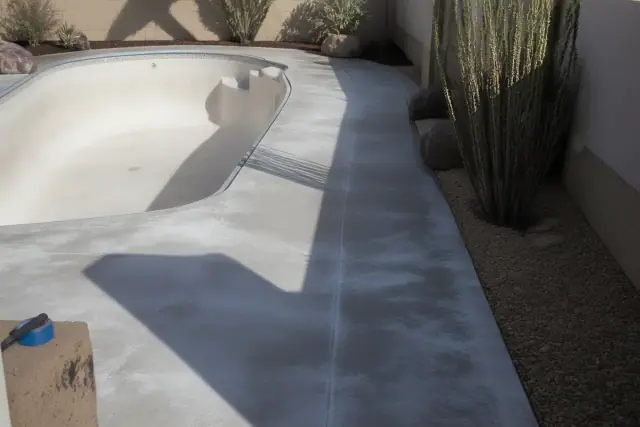
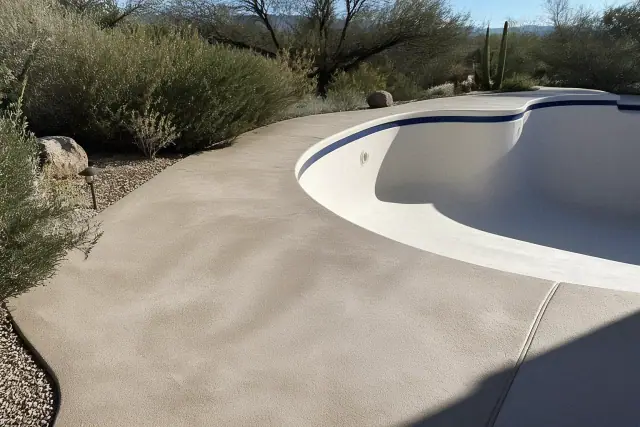
Drained swimming pool with concrete deck surface in Tucson, AZ, ready for a protective sealant application.

We install acrylic cool-deck systems, epoxy pool-area coatings, and polyurethane topcoats. Each offers a different balance of heat reduction, UV stability, chlorine resistance, budget, and cure time, so we explain those tradeoffs before work begins.

Request Estimate

Custom Decorative Pool Deck Systems

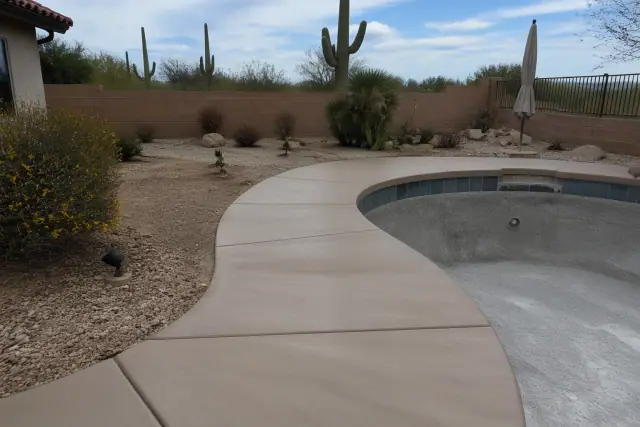
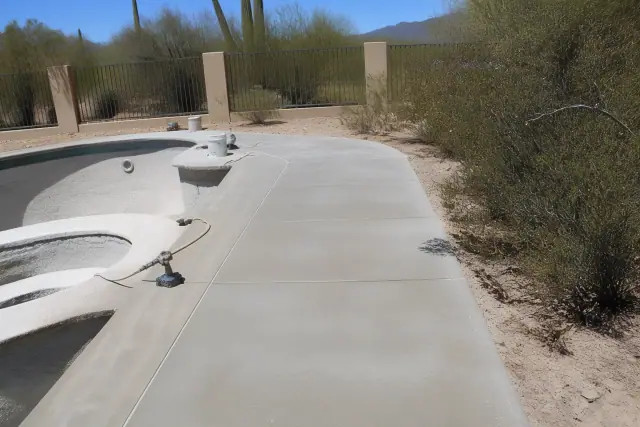
Concrete pool deck being prepped for sealant in Tucson, AZ with saguaro cacti in the background.

Decorative choices include full-flake broadcast systems, metallic finishes with pigmented veining, and solid-color textured coatings. These finishes are built in compatible layers over a mechanically prepared slab and can be coordinated with coping stone or Sonoran desert landscaping.

Request Estimate

Non-Skid Pool Deck Coatings

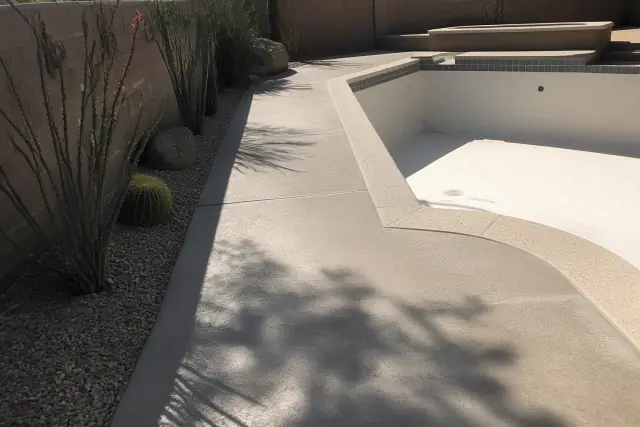
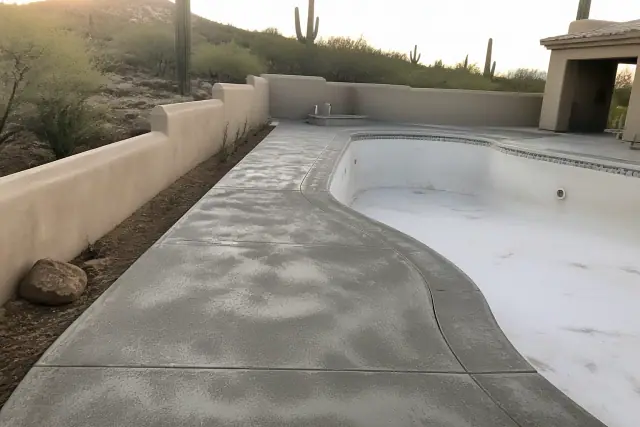
Drained swimming pool with concrete deck waiting for non-skid sealant at a home in Tucson, AZ.

For wet walking areas, we broadcast aluminum oxide or polymer grit into the topcoat at a rate selected for the space. Finished traction is evaluated with ASTM slip-resistance testing methods instead of relying on a vague anti-slip label.

Request Estimate

Pool Deck Resurfacing and Repair

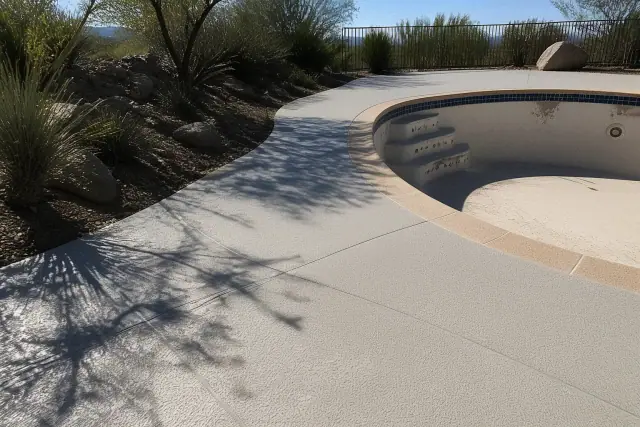
Drained swimming pool deck undergoing resurfacing and repair in Tucson, AZ, with desert plants in the background.

Resurfacing starts by removing failed material, mechanically profiling the slab, and repairing cracks with polyurethane or epoxy fillers rated for slab movement. When the concrete remains structurally sound, a bonded epoxy or polyaspartic overlay can restore the deck without a full tear-out.

Request Estimate

Residential Pool Deck Coatings

Drained swimming pool deck with concrete surfaces ready for sealant in Tucson, AZ, surrounded by desert landscaping.

Residential systems are selected for bare feet, pets, patio furniture, and the daily wear around Tucson backyard pools. We prioritize texture near coping and step-out zones, offer low-VOC formulations, bring physical finish samples to the consultation, and provide system-specific care instructions.

Request Estimate

Commercial Pool Deck Coatings

Concrete pool deck coating in progress at a residential property in Tucson, AZ, with desert landscape in the background.

HOA pools, resorts, and municipal facilities may span several thousand square feet and see hundreds of barefoot crossings per day. We use higher-build commercial topcoats for that traffic and document ASTM slip-resistance testing for property managers, insurance carriers, and facilities reviewed through Pima County Development Services.

Request Estimate
Coating Materials and Finishes

Types of Pool Deck Coating Options

Material chemistry affects heat, cure speed, UV stability, chemical resistance, appearance, and maintenance. These five options cover the most common ways we refresh, protect, decorate, or resurface pool decks in the Tucson climate.

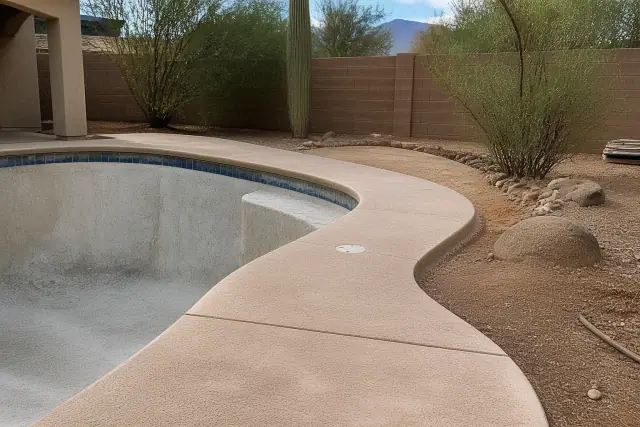
Drained swimming pool with new acrylic cool-deck coating surrounded by desert landscaping in Tucson, AZ.

Acrylic Cool-Deck Coatings

Acrylic cool-deck coatings are a practical choice for straightforward refreshes on concrete that remains in good structural condition. They sit at the more affordable end of the available systems and are designed to reduce underfoot heat.

  • Suitable for recoating sound cool-deck surfaces
  • Lower upfront cost than premium decorative systems
  • Lighter finishes help manage underfoot heat
  • Shorter service life than premium polyaspartic systems
  • Requires proper cleaning, profiling, and compatible repairs
Request Estimate
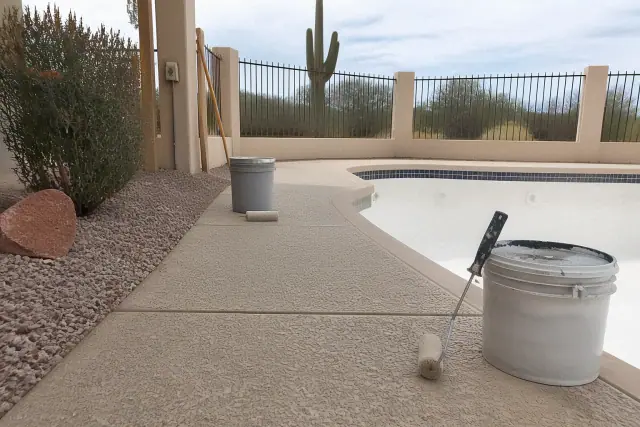
Epoxy coating application on a pool deck with paint rollers and buckets at a job site in Tucson, AZ.

Epoxy Pool Deck Coatings

Epoxy provides strong adhesion and a cost-effective base for many standard installations. Because standard epoxy can amber under prolonged UV exposure, direct-sun decks need a compatible UV-stable finish selected for outdoor use.

  • Strong adhesion to correctly profiled concrete
  • Cost-effective for standard pool-deck installations
  • Available in solid, flake, and decorative applications
  • Can be paired with broadcast aggregate for texture
  • Needs outdoor-rated topcoat protection in prolonged sun
Request Estimate
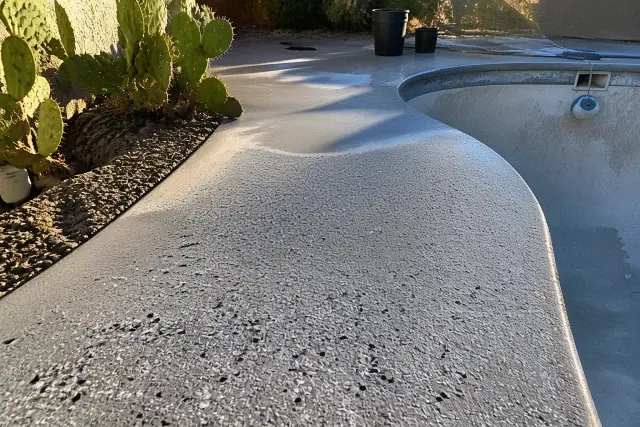
Polyaspartic pool deck coating being applied to a concrete walkway in Tucson, AZ, with visible vinyl flakes.

Polyaspartic Pool Deck Coatings

Polyaspartic coatings cure faster and resist UV yellowing better than standard epoxy. Those attributes make them a strong candidate for exposed Arizona pool decks where direct sun, chlorine splash, and a shorter return-to-use window matter.

  • Better resistance to UV yellowing than standard epoxy
  • Faster curing for reduced pool-area downtime
  • Compatible with flake broadcast and textured finishes
  • Strong resistance to pool chemicals when properly specified
  • Higher upfront investment than basic acrylic recoating
Request Estimate
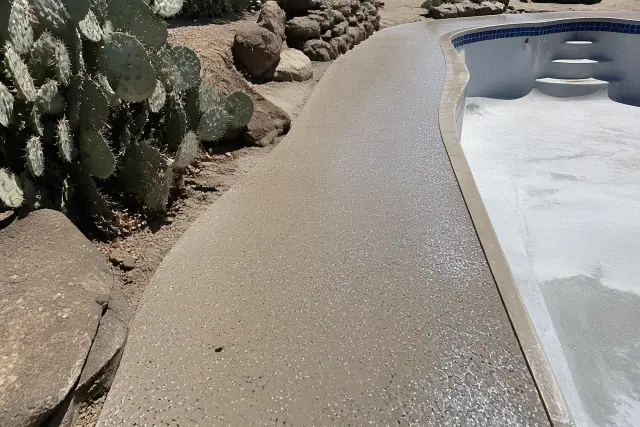
Flake and metallic pool deck coating being applied to a concrete walkway in Tucson, AZ, with surrounding prickly pear cacti.

Flake and Metallic Finishes

Flake and metallic systems add a decorative layer without giving up the performance expected around a pool. Flake helps add texture and camouflage minor surface variation, while pigmented metallic veining creates a marbled, dimensional appearance.

  • Full-flake broadcasts add visual texture
  • Flake blends help disguise minor surface variation
  • Metallic pigments create marbled veining
  • Colorways can complement coping and desert landscaping
  • UV-stable sealing is essential for exposed finishes
Request Estimate
Concrete pool deck coating preparation at a drained swimming pool in Tucson, AZ with a Saguaro cactus in the background.

Bonded Pool Deck Overlays

A bonded epoxy or polyaspartic overlay can restore a deteriorated surface when the underlying slab is still sound. Before recommending it, we check for delamination, deep structural cracking, settlement, and moisture intrusion that could make replacement the better option.

  • Avoids demolition when the existing slab is suitable
  • Supports surface-level crack and spall repair
  • Bonds to mechanically profiled concrete
  • Can be reinforced at control and expansion joints
  • Not recommended for deep structural or sub-slab damage
Request Estimate
Finding the Right Fit

Choosing the Right Pool Deck Coating Approach

We compare slab condition, sun exposure, drainage, expected traffic, finish preferences, heat reduction, chemical resistance, budget, and acceptable downtime. That assessment helps distinguish a basic recoat from a decorative layered system or a repair-focused bonded overlay.

Climate-Matched Coating Selection

Tucson systems must handle freezing overnight lows, summer highs past 105 degrees, monsoon humidity spikes, direct UV, and chlorine contact. We match the base and topcoat chemistry to those conditions rather than treating weather resistance as an optional upgrade.

Mechanical Surface Preparation

We diamond-grind or shot-blast the slab to open its pores and create the appropriate ICRI CSP profile. Mechanical preparation gives repairs and coatings a sound bond; acid etching alone does not provide the same controlled profile.

Slip-Resistance Testing

Our crews are trained in ASTM slip-resistance testing methods and adjust aluminum oxide or polymer grit for the intended wet-use area. The goal is documented traction around coping, entries, and step-out zones, not an unsupported safety slogan.

What Sets Us Apart

Why Choose Tucson Epoxy Co. for Pool Deck Coatings?

Tucson Epoxy Co. combines Arizona Registrar of Contractors credentials with mechanical ICRI-based preparation, ASTM traction testing methods, and low-VOC systems that meet Arizona Department of Environmental Quality guidance. We provide physical finish samples and itemized written quotes, then explain honestly when a structurally damaged slab is not a candidate for an overlay.

Request a Free Estimate

Cracking and Spalling

Spiderweb cracks, expansion cracking, and spalling near pool coping expose weak concrete and allow water and chemicals into the slab. Tucson's monsoon moisture cycles can shift desert soils, while inadequate control joints add stress that must be assessed before coating.

UV Fading and Flaking

Sun-bleached south- and west-facing decks, chalking, and flaking cool-deck material indicate that the existing surface is failing. A replacement system must pair the chosen base with an outdoor-rated topcoat that can resist fading or yellowing.

Extreme Surface Heat

Unprotected concrete surface temperatures can exceed 140 degrees during Tucson summers. Cool-deck materials, lighter finishes, and properly rated topcoats can make the pool surround more usable through July and August than bare concrete or dark pavers.

Slick Wet Areas

Coated concrete can become a fall concern when worn texture turns smooth or a finish lacks enough aggregate. Wet coping, steps, and pool exits need a texture selected for barefoot traffic and evaluated with recognized slip-resistance methods.

Efflorescence and Exposed Aggregate

Chalky white efflorescence, pitting, and exposed aggregate show that the surface skin has deteriorated or moisture is moving through the slab. We identify the condition before choosing repairs so a new coating is not simply placed over an unresolved problem.

Standing Water and Drainage

Low spots and poor slope can leave water standing instead of moving toward deck drains, which accelerates coating failure. A pre-installation slope check reveals drainage corrections that should be addressed before the new system is applied.

How It Works

Our Pool Deck Coating Process

Each project follows a consistent sequence from assessment through cure. The exact repair materials, broadcast aggregate, coating chemistry, film thickness, and recoat windows are then adjusted to the slab and selected finish.

01.

Inspect the Slab

The free estimate begins with a moisture test, crack survey, slope check, and drainage review. We also consider direct-sun exposure and how the space is used before recommending a system.

02.

Mechanically Prepare the Surface

We remove failed material and diamond-grind or shot-blast the concrete to the needed ICRI CSP profile. Opening the slab pores creates a controlled surface for repairs and coatings to bond.

03.

Repair Cracks and Weak Areas

Cracks are filled with polyurethane or epoxy products rated for slab movement, and damaged areas are resurfaced as needed. We also evaluate control joints, expansion joints, delamination, settlement, and moisture intrusion before proceeding.

04.

Apply the Base and Broadcast Layers

The base coat is applied at a controlled film thickness, followed by flake or traction aggregate when the selected system calls for it. Each layer is installed within the manufacturer's recoat window to avoid weak intercoat adhesion.

05.

Seal, Texture, and Test

A compatible weather-, UV-, and chemical-resistant topcoat seals the system. We confirm texture around wet zones and use ASTM slip-resistance testing methods to document finished traction.

06.

Allow Cure and Review Care

Cure time depends on coating chemistry and overnight temperatures, so we confirm when the deck can accept foot traffic and normal pool use. At completion, the owner receives care instructions tailored to the installed system.

Plan Your Pool Deck

Schedule a Pool Deck
Coating
Consultation

Request a free estimate for a Tucson pool deck inspection, material recommendation, and itemized written quote. We will explain the repair, finish, traction, cost, and cure-time tradeoffs before you choose a system.

Pool Deck Coating Help

Pool Deck Coating FAQs

These answers cover Tucson pool deck coating costs, materials, resurfacing, preparation, cure time, traction, and care. A slab inspection is still the best way to determine which option fits a particular pool surround.

Call About Your Pool Deck

Most Tucson pool deck resurfacing projects run $3 to $12 per square foot, with a typical residential job landing between $1,500 and $10,000 depending on size and material choice. Basic acrylic recoats sit toward the lower end, while polyaspartic, flake, and metallic systems cost more because of added material and labor. An itemized estimate shows what drives the final number.

For Tucson's climate, polyaspartic generally resists UV yellowing better and cures faster than standard epoxy. Epoxy remains a strong, cost-effective option for moderate sun or partial shade when paired with a suitable outdoor topcoat. The best choice depends on slab condition, exposure, traction needs, heat reduction, finish, and budget.

Polyaspartic and high-grade acrylic cool-deck systems are strong candidates because they address intense UV, chlorine splash, and large temperature swings. Flake and metallic epoxy finishes can also perform well when sealed with a UV-stable topcoat. Regardless of material, mechanical surface preparation is central to long-term performance.

There is no single product for every slab. Acrylic cool-deck material can refresh concrete in good structural condition, while a bonded epoxy or polyaspartic overlay better suits certain decks with cracking or surface deterioration. We inspect the slab first and match the system to the damage, exposure, and desired finish.

High-quality concrete pool deck coatings generally last 10 to 15 years before full replacement when installed and maintained correctly. Basic acrylic recoats commonly need attention after 3 to 5 years. Preparation quality, coating thickness, direct sun, pool chemicals, and maintenance all affect the actual interval.

Requirements vary by property type, and there is no single blanket texture rule for every residential backyard. Commercial and multi-family facilities are generally expected to meet recognized slip-resistance benchmarks, and facilities reviewed through Pima County Development Services need adequate wet-area traction. We recommend aggregate texture for residential decks as well and test finished surfaces with recognized ASTM methods.

Often, yes, when damage is limited to surface cracking, spalling, or a failed prior coating and the slab remains structurally sound. We mechanically profile the surface, complete suitable repairs, and install a bonded overlay; deep structural cracks, significant settlement, or sub-slab moisture can make replacement necessary. Demolition, haul-off, and repour can run $35 to $50 per square foot, so the inspection determines whether an overlay is a sound alternative.

Most residential pool decks are back in use within 3 to 5 days, depending on coating chemistry and overnight temperatures. Polyaspartic systems cure faster than standard epoxy and can often allow foot traffic within 24 hours. We provide the return-to-use schedule for the specific system before work starts.

Preparation begins with moisture, crack, slope, and drainage checks. We then diamond-grind or shot-blast the slab to the required ICRI CSP profile, remove failed material, and repair cracks with compatible polyurethane or epoxy fillers. We do not rely on acid etching alone.

Square footage, existing cracks or spalling, drainage corrections, coating type, and decorative flake or metallic work all affect price. Acrylic cool-deck recoats are roughly $3 to $6 per square foot, while full deck replacement can run $8 to $21 or more per square foot once demolition is factored in. Extensive failed coatings require more preparation time and raise the final quote.

Available looks include solid-color textured coatings, full-flake broadcasts, and metallic finishes with pigmented veining. Flake adds texture and helps camouflage minor surface variation, while metallic systems create a marbled effect. Physical samples can be compared with travertine coping, stone, and desert-tone landscaping before selection.

Routine care consists of simple rinsing and addressing spills or pool chemicals according to the system-specific instructions. Resealing may be appropriate every few years depending on direct-sun exposure and coating type. We provide care guidance at project completion.

Yes, higher-build commercial systems are available for HOA pools, resorts, and municipal facilities with frequent barefoot traffic. The coating, texture, and topcoat are selected for UV, chemical exposure, and operating demands, and finished traction can be documented with ASTM testing methods. Facility condition and acceptable downtime are reviewed before the system is specified.