Proudly serving Tucson, Oro Valley, Marana, Vail, Sahuarita, Green Valley & surrounding areasCall or Text 24/7: +1 (520) 567-9887

Polyaspartic Floor Coatings and Fast-Cure Installation Services in Tucson, AZ

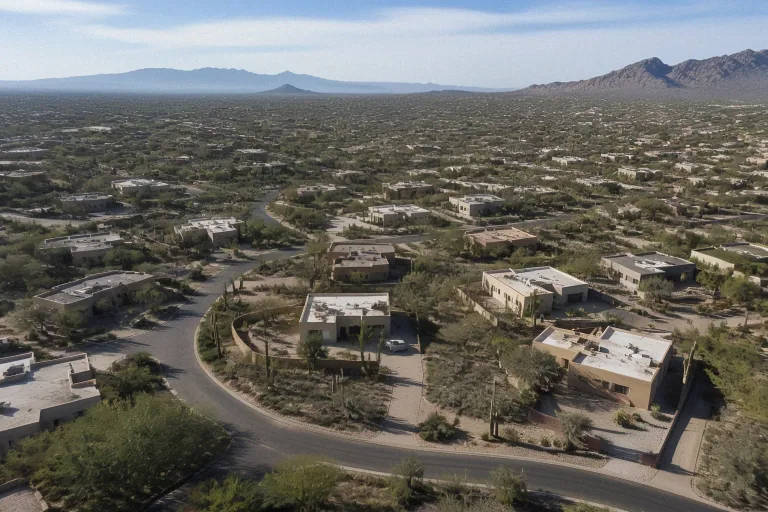
Tucson Epoxy Co. installs polyaspartic floor coatings for homes and businesses in Tucson, Arizona. Our crews coat garages, patios, pool decks, retail spaces, warehouses, and other concrete floors exposed to heavy traffic or desert sun. We also install garage floor epoxy, flake and metallic finishes, commercial and industrial epoxy flooring, and concrete repair and resurfacing. Service extends across Tucson, Oro Valley, Marana, Sahuarita, and the greater Pima County metro area.

Tucson concrete faces conditions that punish ordinary coatings. On unshaded garage slabs, summer surface temperatures can climb well past 140°F, while monsoon humidity can swing within hours. Continuous UV exposure can yellow and chalk standard epoxy, and expansive caliche soils can shift slabs seasonally. We match the resin system to the slab, mechanically profile the surface, test moisture when needed, and explain whether polyaspartic or epoxy fits the space.

Most residential garage and patio projects use a two-part or three-coat polyaspartic system, and each installation is backed by a 15-year warranty covering material defects and adhesion failure under normal use. Request a free on-site estimate for a direct assessment of the slab and its preparation needs.

Tucson Epoxy Co. installs polyaspartic floor coatings throughout Tucson and nearby Oro Valley, Marana, Sahuarita, and the greater Pima County metro area.

★ ★ ★ ★ ★4.9/5 Average Rating · 20+ Years of Experience · Thousands of Customers Helped · Licensed & Insured · Residential & Commercial

Polyaspartic Flooring Options & Benefits

What Are Polyaspartic Floor Coatings?

Polyaspartic is an aliphatic polyurea resin originally developed for bridge decking and industrial coatings, then adapted for concrete floors. It cures through a fast catalytic reaction and can serve as a standalone high-build coating or a clear topcoat over decorative flake or metallic epoxy.

Epoxy is thicker and slower curing, with strong concrete adhesion and useful cost efficiency on interior floors. A coat of epoxy may need 24-72 hours to become walkable, while a comparable polyaspartic coat can cure in as little as 1-4 hours. Built-in UV stabilizers also help polyaspartic stay clear and color-stable in direct sun.

Polyaspartic cures across a wider temperature range, which is useful during Tucson's 100-degree-plus stretches. Its slight flexibility, UV resistance, and fast cure make it a practical choice for patios, pool decks, and garages that receive direct sun through an open door.

Benefits of Polyaspartic Floor Coatings

For Tucson garages, patios, and commercial floors, polyaspartic combines a fast return to use with concrete protection suited to intense sun, shifting moisture, and regular traffic. The final system can also carry decorative color, texture, and gloss without sacrificing a UV-stable top surface.

  • Walkable in 4-8 hours on most installations
  • Ready for vehicle traffic within about 24 hours
  • Resists the yellowing and chalking caused by direct UV exposure
  • Cures across a wider temperature range than standard epoxy
  • Flexes slightly as expansive caliche soils shift slabs seasonally
  • Accepts full- or partial-broadcast decorative vinyl flakes
  • Supports slip-resistant texture for patios and pool decks
  • Engineered for 20-25 years of normal residential or light commercial use
Concrete Coating Services

Polyaspartic & Epoxy Flooring Services

We tailor coating chemistry, build thickness, decorative finish, and slip resistance to the surface and how it will be used. Residential work ranges from garages and patios to pool decks, while commercial and industrial systems address abrasion, foot traffic, washdown, grease, and solvents.

Polyaspartic Garage Floors

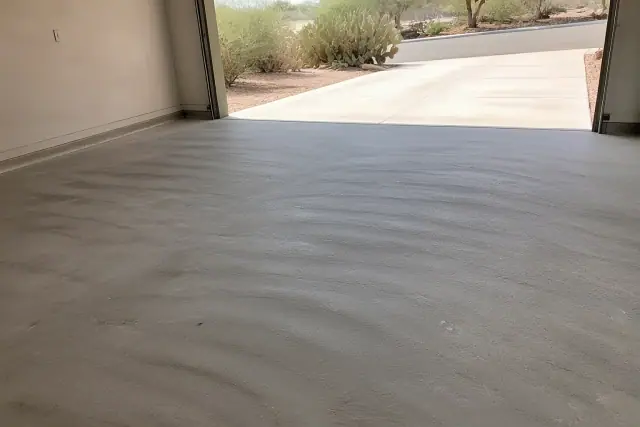
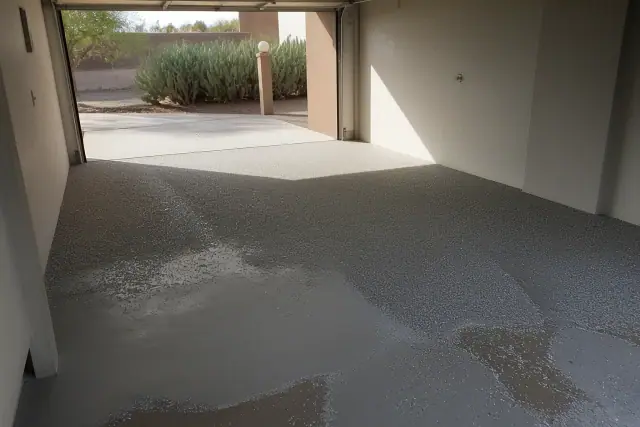
Empty two-car residential garage floor prepped for polyaspartic coating in Tucson, AZ, with desert landscape outside.

We install traditional epoxy or polyaspartic in standard two- or three-car garages based on sun exposure, budget, and traffic. A typical two-car garage covers 400-500 square feet, and homeowners can compare color chips, flake blends, and matte, satin, or high-gloss finishes before scheduling.

Request Estimate

Patio Floor Coatings

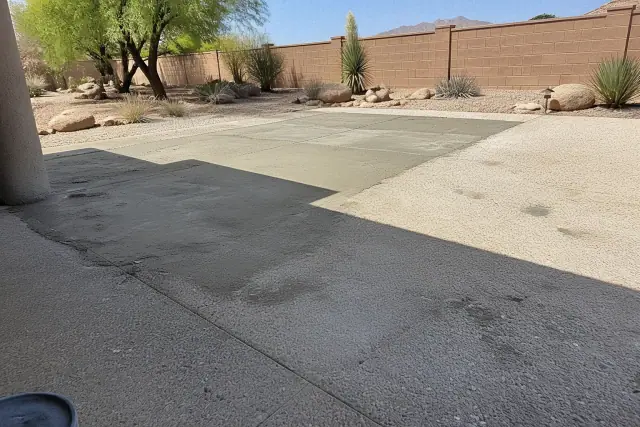
Concrete patio surface preparation for polyaspartic coating at a home in Tucson, AZ.

Polyaspartic patio coatings seal concrete against staining and UV fade caused by monsoon runoff and direct desert sun. Slip-resistant texture can be added for uncovered patios, covered ramadas, and areas next to a pool.

Request Estimate

Pool Deck Coatings

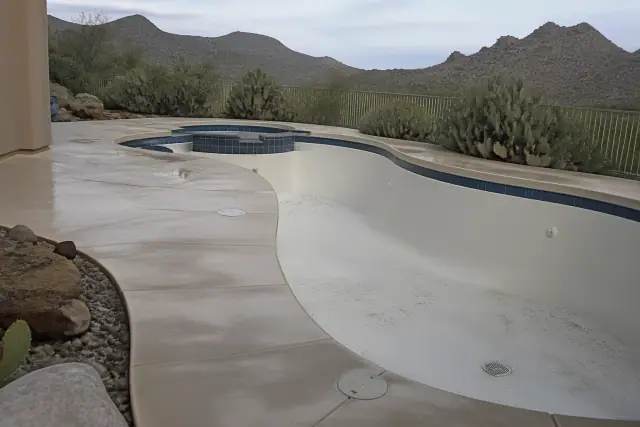
Polyaspartic floor coating on a drained pool deck in Tucson, AZ with desert mountains in the background.

Textured polyaspartic pool deck coatings are designed for chlorine splash, sunscreen residue, bare feet, and sustained UV exposure. They stay cooler underfoot than bare concrete or standard paint, resist chemical staining, and hold their color better than acrylic pool deck coatings.

Request Estimate

Commercial Epoxy Flooring

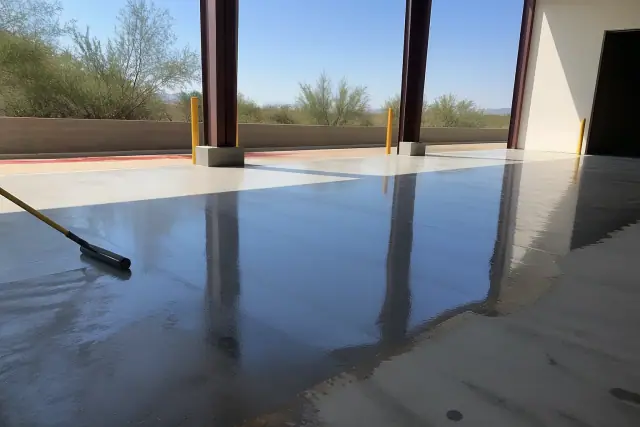
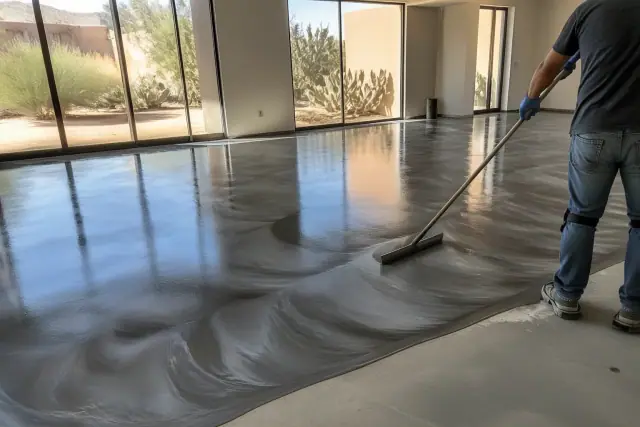
Half-applied glossy epoxy coating on an industrial concrete floor at a job site in Tucson, AZ.

Warehouse and distribution floors near the Tucson airport and I-10 require more build than a residential-grade coating. We specify high-build epoxy or polyaspartic with reinforced mil thickness for forklift traffic, pallet jacks, and constant abrasion, while decorative flake or metallic floors suit showrooms, offices, and retail spaces.

Request Estimate

Industrial Epoxy Floors

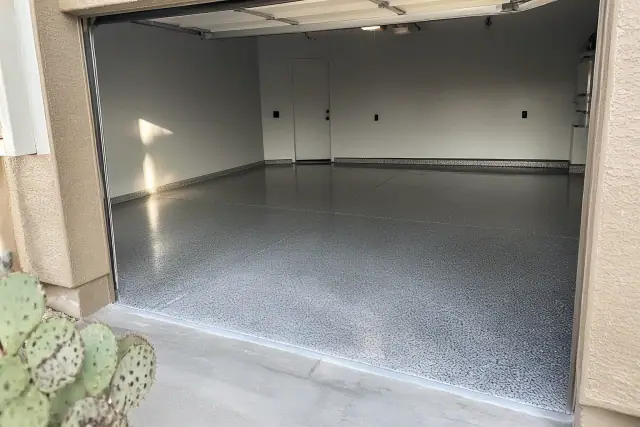
Freshly installed epoxy floor with decorative flakes in a residential garage in Tucson, AZ, with desert landscaping outside.

Industrial epoxy systems serve breweries, automotive shops, food-service kitchens, and other floors exposed to grease, solvents, or frequent washdown. Formulations are selected for chemical resistance and the slip-resistance expectations applied to food-service and healthcare flooring by health inspectors and Pima County code officials.

Request Estimate

Concrete Repair & Resurfacing

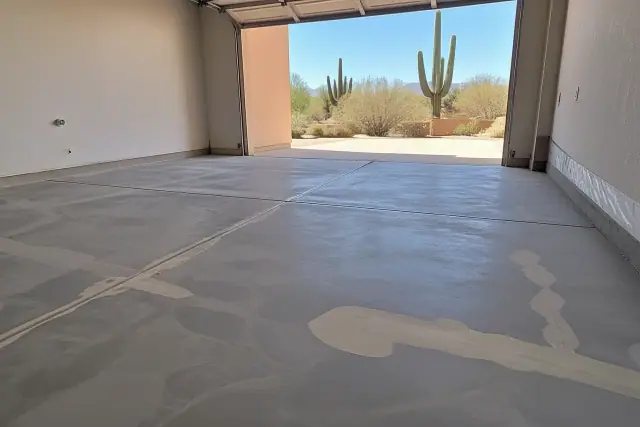
Prepped concrete garage floor with crack filler and grinding marks for a polyaspartic coating project in Tucson, AZ.

Before coating, we repair cracks and spalls with polymer-modified repair mortar so damaged areas do not remain weak points in the finished floor. Mechanical resurfacing also removes oil, sealers, and slick trowel finishes that can prevent a coating from bonding.

Request Estimate
Coating & Finish Choices

Polyaspartic Coating Options

A coating plan can combine a primer or densifier, pigmented base, decorative broadcast, and one or two polyaspartic topcoats. We choose the layer count and finish for the slab's condition, sun exposure, traffic, moisture risk, and desired appearance.

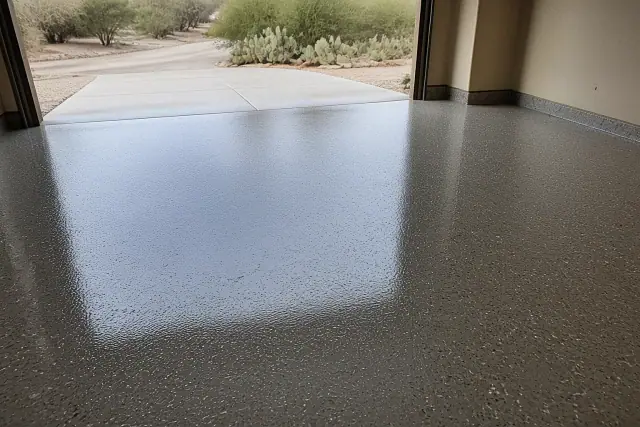
Empty residential garage in Tucson, AZ with freshly applied high-gloss polyaspartic floor coating and prickly pear cactus.

Two-Coat Polyaspartic System

A two-coat system uses a base coat followed by a clear or pigmented polyaspartic topcoat. It is the standard specification for many garage and patio installations when the slab is properly profiled and a decorative build does not require an additional layer.

  • Pigmented polyaspartic base coat
  • Clear or pigmented protective topcoat
  • Fast, controlled application window
  • UV-stable finish for sun-exposed concrete
  • Suitable for many garage and patio slabs
Request Estimate
Polyaspartic floor coating with decorative flakes on a concrete garage floor in Tucson, AZ.

Three-Coat Broadcast Flake System

A broadcast flake system combines a pigmented base with vinyl chips at full or partial coverage, then seals the surface beneath a clear polyaspartic topcoat. It is the most requested residential finish described in the source because it adds texture and disguises minor slab imperfections.

  • Pigmented base chosen for the flake blend
  • Full- or partial-coverage vinyl chip broadcast
  • Clear polyaspartic wear layer
  • Added texture for slip resistance
  • Decorative finish for garages, patios, and showrooms
Request Estimate
Contractor applying wet metallic epoxy floor coating to a prepared concrete surface in Tucson, AZ.

Metallic Epoxy Finish

Metallic epoxy uses mica pigments manipulated with brushes, blowers, or squeegees to create a dimensional, marbled floor. A polyaspartic wear coat can protect the decorative layer in showrooms, offices, and high-end residential interiors.

  • Mica pigments create dimensional movement
  • Brush, blower, or squeegee application effects
  • Marbled appearance rather than flat color
  • Designed for statement floors
  • Clear protective topcoat option
Request Estimate
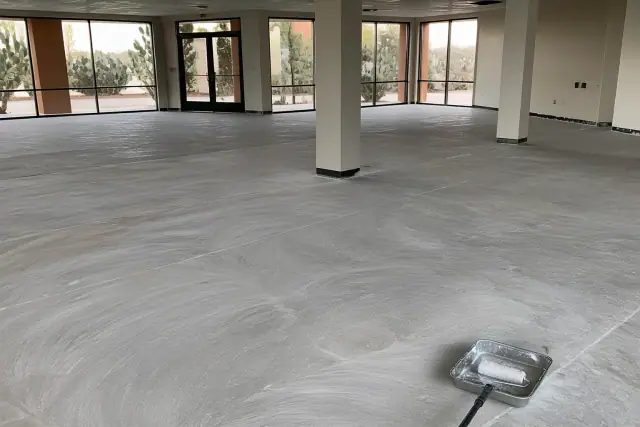
Sanded concrete floor prepared for polyaspartic coating at a Tucson, AZ retail showroom with cactus visible outside.

High-Build Commercial Coatings

High-build epoxy and polyaspartic floors use reinforced mil thickness where forklifts, pallet jacks, foot traffic, or frequent cleaning would wear through a standard residential coating. The specification can emphasize abrasion resistance, chemical resistance, or a clean decorative appearance.

  • Reinforced build for high-traffic lanes
  • Abrasion resistance for warehouse equipment
  • Chemical-resistant industrial formulations
  • Easy-to-maintain surfaces without grout lines
  • Decorative choices for retail and office floors
Request Estimate
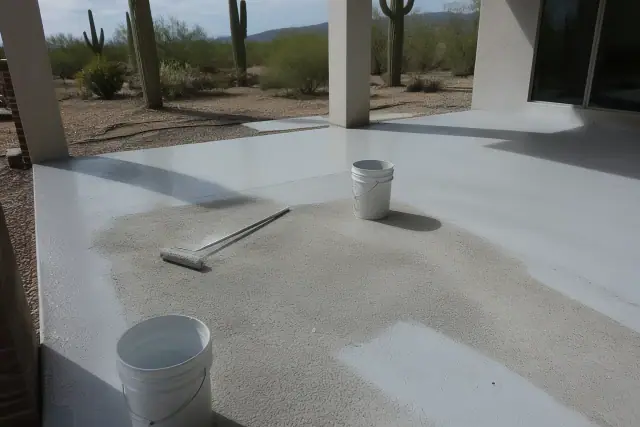
Contractor applying a decorative UV-rated coating to a concrete patio during a project in Tucson, AZ.

UV-Rated Outdoor Coatings

Outdoor coating performance depends on UV stabilizers in the topcoat, not only the base layer. Patio and pool deck systems pair color-stable polyaspartic protection with texture selected for uncovered concrete, pool-adjacent areas, and year-round use.

  • UV stabilizers in the protective topcoat
  • Color stability under sustained desert sun
  • Texture additives for slip resistance
  • Resistance to pool chemicals and stains
  • Finish options for patios, ramadas, and pool decks
Request Estimate
Finding the Right Fit

Choosing the Right Floor-Coating Approach

The right coating depends on whether a floor is interior or UV-exposed, how much traffic it carries, the slab's moisture and repair needs, the decorative finish, and the available budget. Standard epoxy still offers strong build and cost efficiency for shaded interiors; polyaspartic is usually the more durable option for Tucson surfaces exposed to direct sun.

Climate-Matched Coating Selection

We install both epoxy and polyaspartic and recommend between them based on sun exposure, traffic, budget, and the required return-to-use window. That lets an interior floor use epoxy where it makes sense while an outdoor or sunlit surface receives the stronger UV package.

Mechanical Surface Profiling

Every slab is mechanically profiled with diamond grinding or shot blasting to an ICRI CSP 3 surface. This controlled texture gives the coating a sound bond instead of relying on a slick trowel finish or a chemical etch.

Moisture Testing & Warranty

Where vapor drive is a concern, especially in older Tucson homes without a vapor barrier, we use an ASTM F2170 relative-humidity probe test before coating. Polyaspartic installations include a 15-year warranty for material defects and adhesion failure under normal use.

What Sets Us Apart

Why Choose Us for Polyaspartic Coatings?

Tucson Epoxy Co. combines slab evaluation, moisture testing when needed, mechanical preparation, concrete repair, controlled application, and a coating selected for local heat and UV exposure. A free on-site estimate gives you a direct recommendation before you commit to a system.

Request Free On-Site Estimate

UV Yellowing & Chalking

Standard epoxy exposed to Tucson sun can begin yellowing or chalking after 12-24 months. A UV-stabilized polyaspartic topcoat is designed to remain clear and color-stable on garages, patios, and pool decks that receive direct sun.

Moisture Vapor & Delamination

Moisture moving through an older slab can weaken adhesion when the concrete has no effective vapor barrier. Relative-humidity testing identifies that risk before a fast-curing coating traps moisture beneath the finished surface.

Poor Surface Preparation

Roughly a third of coating failures we are called to fix trace back to inadequate preparation. Oil, sealer residue, and slick trowel finishes must be removed before the slab can accept a dependable coating bond.

Cracks, Spalls & Slab Movement

Expansive caliche soils can contribute to seasonal slab movement, while impact and wear leave cracks or spalled areas. We patch those defects with polymer-modified repair mortar before applying the coating layers.

Abrasion & Chemical Exposure

Forklifts, pallet jacks, grease, solvents, and washdown can overwhelm a light-duty finish. Standard residential-grade coatings may wear through high-traffic lanes within a year or two, so commercial floors need the build thickness and chemistry matched to their use.

Hot or Slippery Outdoor Concrete

Bare pool-deck and patio concrete can become hot underfoot while chlorine, sunscreen, monsoon runoff, and stains collect at the surface. Textured polyaspartic systems add slip resistance and help outdoor concrete retain its finish under sustained UV exposure.

How It Works

Our Polyaspartic Coating Process

A durable coating starts with the slab rather than the color choice. Our process evaluates the concrete, addresses moisture and damage, creates the required profile, applies each layer at consistent thickness, and allows the finished system to cure before normal use.

01.

On-Site Slab Evaluation

During the free on-site estimate, we inspect the slab for cracks, spalls, existing sealers, oil, sun exposure, traffic, and decorative goals. We then recommend epoxy, polyaspartic, or a combined decorative system based on the actual surface.

02.

Moisture Testing

When vapor drive may affect adhesion, we use an ASTM F2170 relative-humidity probe test. The reading informs the primer and coating plan before material is placed on the slab.

03.

Mechanical Surface Profiling

Diamond grinders or shot blasters remove contamination and open the concrete to an ICRI CSP 3 profile. This step creates the consistent surface texture needed for mechanical adhesion.

04.

Concrete Repairs

Cracks and spalls are patched with polymer-modified repair mortar after the slab is exposed. Repairs are blended into the prepared surface so the coating does not simply hide an untreated defect.

05.

Coating & Decorative Broadcast

We apply a densifier or primer, the base coat, and any selected flake or metallic broadcast. Each liquid layer is squeegeed and back-rolled to consistent mil thickness while temperature and humidity are controlled for the resin's cure behavior.

06.

Topcoat, Cure & Return to Use

One or two polyaspartic topcoats complete the system, depending on the build and decorative specification. Most garage floors are walkable in 4-8 hours and ready for vehicle traffic in about 24 hours, allowing many projects to move from bare concrete to a finished floor in one day.

Plan Your Concrete Coating

Schedule a Polyaspartic
Floor Coating
Estimate

Request a free on-site estimate for your Tucson garage, patio, pool deck, commercial floor, or industrial space. We will walk the slab, explain preparation and finish options, and recommend a system based on sun exposure, traffic, moisture, and budget.

Coating Questions

Polyaspartic Floor Coating FAQs

Compare cost, cure time, preparation, finish, lifespan, and outdoor performance before choosing a concrete coating. These answers reflect the polyaspartic and epoxy systems described for Tucson homes and businesses.

Call About Floor Coatings

Professionally installed polyaspartic flooring typically costs $5 to $12 per square foot, while DIY kits run about $2 to $5 per square foot but do not include professional mechanical profiling or mil-thickness control. A standard 400-500-square-foot two-car garage generally falls between $2,000 and $4,500 installed. Surface preparation, coat count, and flake or metallic additions account for much of the variation.

Polyaspartic costs more upfront than standard epoxy, and its fast cure gives installers less time to correct application errors. It also requires precise surface preparation and moisture evaluation because a fast-curing resin will not compensate for a poorly profiled or damp slab. For UV-exposed Tucson floors, the added cure speed and color stability can outweigh those tradeoffs.

Polyaspartic is usually the stronger choice for outdoor or UV-exposed Tucson floors because it resists yellowing and chalking and cures in hours rather than days. Standard epoxy still provides strong build and cost efficiency for shaded interior floors. The better choice depends on sun exposure, traffic, budget, and the required cure window.

At the stated $5 to $12 per square foot range, a 210-square-foot Tucson patio typically costs $1,050 to $2,520 installed. Outdoor UV-rated topcoats, slip-resistant additives, crack repairs, and the selected decorative finish can move a project toward the higher end. Exact pricing requires an on-site look at the slab.

Most polyaspartic floors are walkable in 4-8 hours after the final coat and ready for vehicle traffic in about 24 hours. Standard epoxy may require 3-5 days across coats and full cure, with about 5-7 days before vehicle traffic in the comparison provided. Actual cure is managed around the application's temperature and humidity.

Yes. A base coat followed by a clear or pigmented topcoat is the standard two-coat specification for many garages and patios. A third coat may be used for a heavier decorative build or additional UV protection.

Polyaspartic floors are engineered for about 20-25 years under normal residential or light commercial use. Standard epoxy is described as lasting roughly 5-7 years before recoating is needed. Traffic, surface preparation, moisture, sun exposure, and maintenance all affect real service life.

Tucson Epoxy Co. backs its polyaspartic installations with a 15-year warranty. The source states that it covers material defects and adhesion failure under normal use conditions. The installation recommendation is still matched to the slab and exposure before work begins.

The slab is diamond-ground or shot-blasted to an ICRI CSP 3 profile, then cracks and spalls are patched with polymer-modified repair mortar. Oil, sealers, and slick trowel finishes are removed rather than coated over. An ASTM F2170 relative-humidity probe test is used where vapor drive is a concern.

Many polyaspartic garage floors can move from bare concrete to a finished, walkable surface in a single day because each coat cures quickly. Individual coats can cure in as little as 1-4 hours, compared with 24-72 hours for epoxy to become walkable. Concrete repairs, moisture conditions, decorative build, temperature, and humidity can change the schedule.

The company installs residential and commercial coatings throughout Tucson, Oro Valley, Marana, Sahuarita, and the greater Pima County metro area. Supported surfaces include garages, patios, pool decks, retail and office floors, showrooms, warehouses, and industrial spaces.

Broadcast flake systems use vinyl chips at full or partial coverage beneath a clear topcoat, while metallic epoxy uses manipulated mica pigments for a dimensional marbled look. Garage customers can also compare color chips and matte, satin, or high-gloss finishes. The final choice is coordinated with traffic, texture, and sun exposure.

Yes, polyaspartic is the recommended system in the source for outdoor concrete exposed to Tucson sun. UV stabilizers help resist yellowing and chalking, while textured additives provide slip resistance around patios and pools. Its wider application-temperature range also helps during Tucson's heat swings.