Garage Floor Epoxy
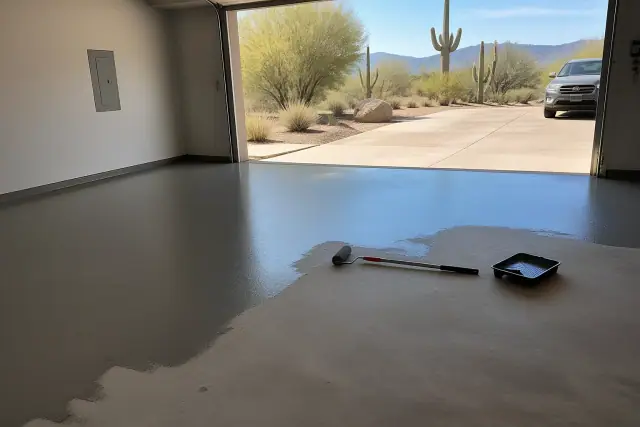
Choose solid-color, quartz, or flake garage floor epoxy based on traffic and appearance. A properly prepared system resists hot-tire pickup plus the oil and coolant drips that can permanently stain bare concrete.
Explore Service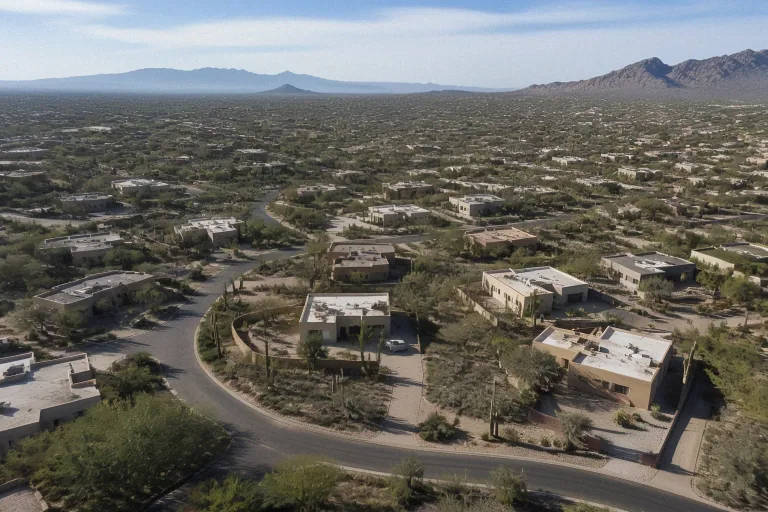
Tucson Epoxy Co. installs garage floor epoxy, concrete floor coatings, and polyaspartic floor coatings for homes and businesses in Catalina Foothills, Arizona. The same crew also handles commercial and industrial epoxy flooring, flake and metallic finishes, patio and pool deck coatings, and concrete repair and resurfacing. Each project begins with an honest slab assessment so the selected system fits the space, exposure, traffic, and finish goals. Our crew manages preparation, application, and finishing in-house from start to finish.
Foothills concrete faces intense UV exposure, monsoon runoff, and movement associated with expansive caliche soil. Custom hillside homes, mid-century ranch properties, and newer builds can each present different moisture and surface-preparation needs. An unsuitable coating or weak preparation can lead to yellowing, blistering, delamination, and peeling. We evaluate the slab and explain the practical system choices before asking you to commit.
Catalina Foothills is an unincorporated Pima County community of roughly 50,796 residents in the southern foothills of the Santa Catalina Mountains. We work around Sunrise Drive, Skyline Drive, Ventana Canyon, Finger Rock, Sabino Canyon, and other supported parts of the community.
These options cover residential, commercial, and industrial concrete, with the final specification based on slab condition, traffic, UV load, chemical exposure, and desired appearance. For a project in nearby Casas Adobes, AZ , review the dedicated location details before requesting an on-site estimate.
Choose solid-color, quartz, or flake garage floor epoxy based on traffic and appearance. A properly prepared system resists hot-tire pickup plus the oil and coolant drips that can permanently stain bare concrete.
Explore Service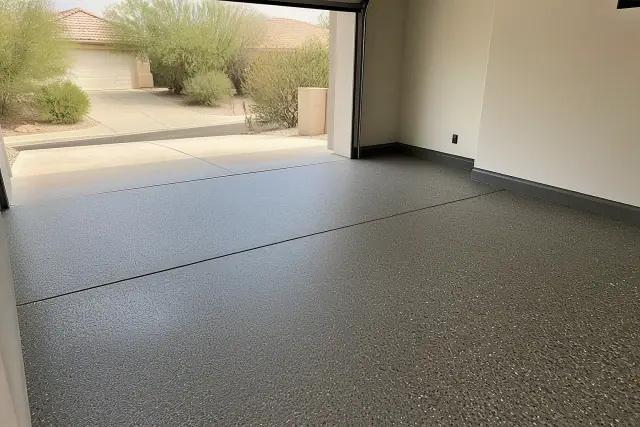
Concrete floor coatings can protect interior residential, retail, medical-office, showroom, and workshop slabs. We match the resin, build thickness, surface texture, and topcoat to how the floor will actually be used.
Explore Service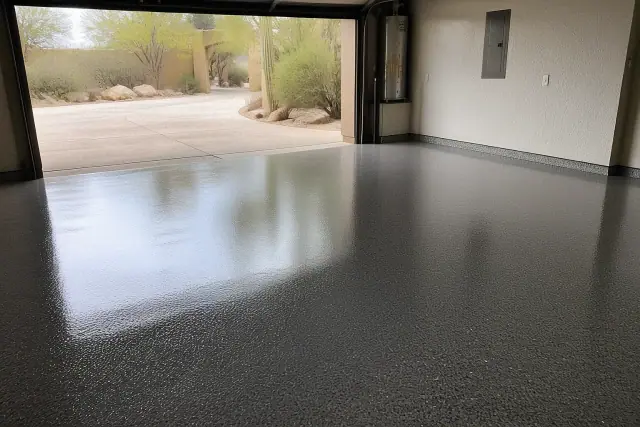
Polyaspartic floor coatings cure faster and resist UV yellowing better than traditional epoxy. A polyaspartic topcoat over an epoxy base is often a practical choice for garages and exposed areas that need a durable finish with less risk of amber discoloration.
Explore Service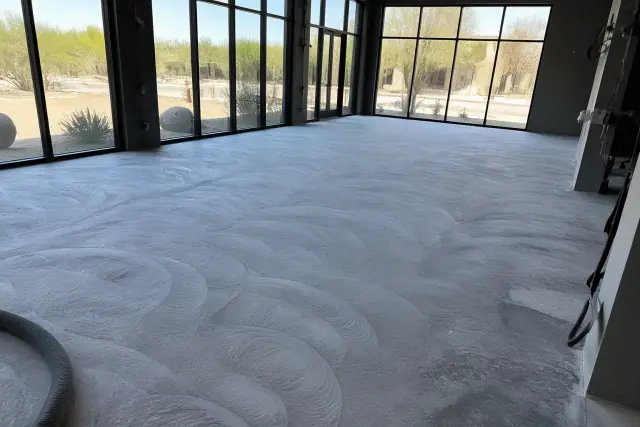
Commercial systems for retail buildouts, medical offices, and professional offices along Sunrise Drive and River Road are specified for rolling loads, foot traffic, daily cleaning chemicals, and measured adhesion. ASTM C1583 tensile adhesion results can guide the system, and phased installation can help limit downtime.
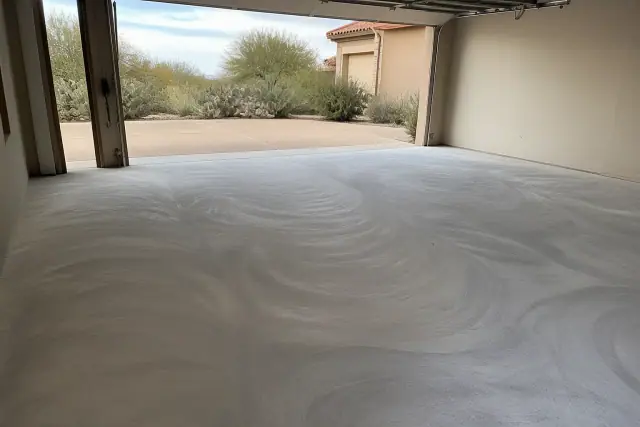
Warehouses, workshops, and light-manufacturing areas may need industrial systems built at 20-30 mils or more. Aggregate broadcast adds slip resistance for forklift and pallet-jack traffic, while the coating build helps resist abrasion, chemical spills, and thermal shock.
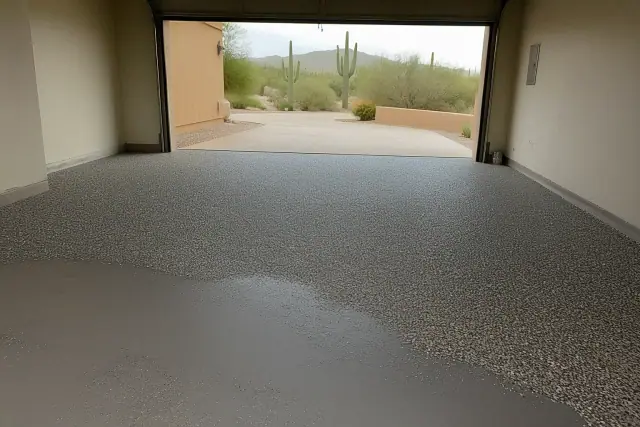
Colored vinyl chips are broadcast into a base coat and sealed beneath a clear topcoat. Flake systems add texture, disguise minor slab imperfections, and come in dozens of blends ranging from subtle earth tones to high-contrast combinations.
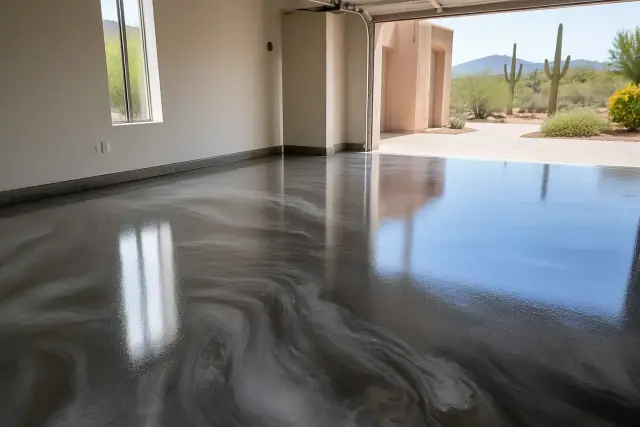
Mica pigments suspended in clear epoxy are manipulated while wet to produce a three-dimensional, marbled appearance. Because no two pours look identical, metallic epoxy suits statement garages, entryways, and showrooms that call for a custom finish.
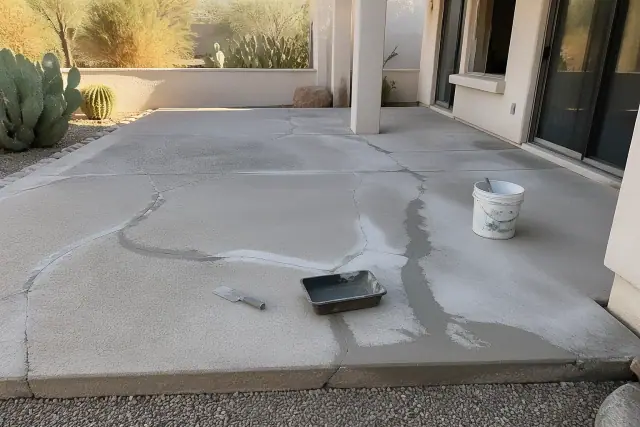
Exterior patio coatings need UV-stable topcoats and slip-resistant additives to handle direct sun, monsoon downpours, and desert grit. The system should balance decorative appearance with practical traction and weather exposure.
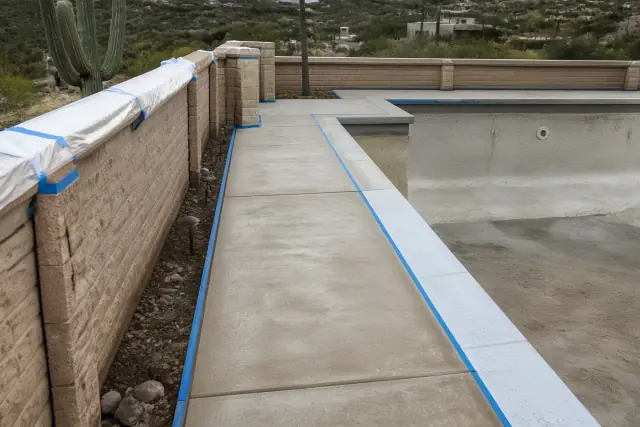
Textured, breathable pool deck systems can reduce surface temperature compared with bare concrete or a standard broom finish while improving traction around wet areas. Material selection also accounts for chlorine exposure and the occasional freeze-thaw cycle.
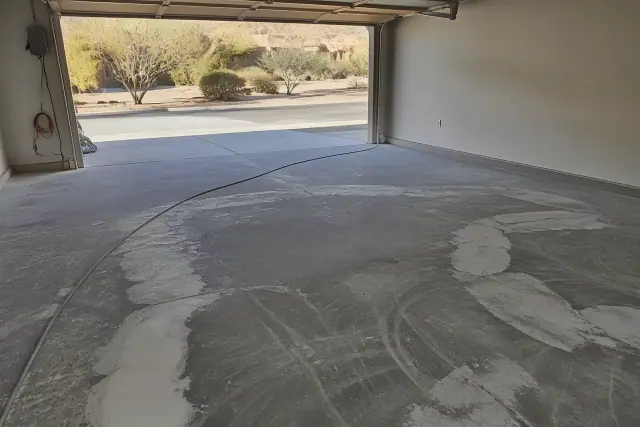
Cracking, spalling, and pitting must be addressed before a finish coat is installed. Depending on severity, preparation may include polymer-modified resurfacing compounds or epoxy crack injection to restore a sound coating substrate.
The right floor system depends on the slab, exposure, traffic, appearance, and acceptable return-to-service window. These six checks help separate a good specification from a one-size-fits-all coating.
A residential garage, medical office, warehouse, patio, and pool deck place different demands on a floor. Start with the property's actual use, cleaning routine, rolling loads, and finish goals before choosing epoxy, polyaspartic, quartz, flake, or polished concrete.
Exposed concrete can exceed 140 degrees in July, while ambient highs stay above 105 degrees for weeks. UV load, slab temperature, and door orientation affect product choice and may require early-morning application during peak summer.
Caliche can limit drainage and contribute to moisture retained after monsoon storms. Moisture-vapor testing helps prevent a coating from being trapped over a damp slab and failing early.
Daily cleaners, rolling carts, pallet jacks, forklifts, oil, coolant, and chemical spills require different resin builds. Commercial and industrial floors should be specified around their actual exposure instead of appearance alone.
Flake, quartz, and other aggregate broadcasts can add texture where dust, grit, or water is common. The right texture should improve footing without making routine cleaning unnecessarily difficult.
Solid-color, flake, quartz, metallic, and polished finishes create different looks and maintenance profiles. Cure time also matters, especially when the property has only one garage bay or a business must remain operational.
Many coating failures begin below the finish layer. Identifying UV exposure, moisture, cracking, staining, and weak surface preparation first allows the repair and coating plan to address the actual cause.
Request Slab InspectionTraditional epoxy can amber or chalk when direct Arizona sun reaches the floor repeatedly. A UV-stable polyaspartic topcoat is often the better finish for west-facing garages, patios, and other exposed slabs.
Heat can push moisture vapor through an unsealed slab and create bubbles or delamination under an unsuitable coating. Homes built from the 1970s through the 1990s may lack a proper vapor barrier, making moisture testing especially important.
Dense calcium-carbonate caliche limits drainage in much of the foothills. After monsoon storms, retained slab moisture can interfere with adhesion unless the system and preparation account for it.
Expansive-soil movement can leave settlement cracks, while weather and wear can cause spalling or pitting. Structural concerns and damaged concrete need more than a cosmetic skim coat before flooring is applied.
Summer-heated tires can pull at a weak coating, while oil and coolant soak into bare concrete. Mechanical profiling and a system chosen for garage traffic reduce those common failure and staining risks.
A quick acid etch may not create the concrete surface profile needed for reliable adhesion. Diamond grinding or shot blasting opens the pore structure and removes weak surface material before primer is applied.
Our crew combines local slab knowledge with mechanical preparation, application standards, and commercial-grade materials. We explain the system, product data, cure requirements, and workmanship coverage before the contract is signed.
We understand the grading, heat, and slab conditions around Sunrise Drive, Skyline Drive, Ventana Canyon, Finger Rock Wash, and Sabino Canyon. The company carries the licensing required for coating and resurfacing work in Pima County and addresses permits when the project scope requires them.
Moisture checks, adhesion testing, crack evaluation, and mechanical profiling guide the installation. Crews follow manufacturer application standards and practices consistent with International Concrete Repair Institute preparation guidance.
Commercial-grade epoxy resins and polyaspartic topcoats are selected for the slab's UV, traffic, and chemical exposure. Coverage details vary by system, but adhesion failure or a coating defect caused by the installation process is addressed under the stated workmanship terms.
Each project moves from diagnosis to preparation, repair, coating, and a cure-specific handoff. Slab and ambient conditions are tracked so each layer is installed within the product's workable window.
We inspect the space, discuss traffic, chemicals, sun exposure, appearance, and downtime, then recommend a system that fits those conditions.
The crew checks for cracks, spalling, pitting, stains, and moisture-vapor concerns. Commercial specifications may also use ASTM C1583 tensile adhesion testing.
Diamond grinding or shot blasting opens the concrete pore structure and creates a profile comparable to SSPC-SP13/NACE 6 guidance. Dust and loose material are removed before repair or primer.
Settlement cracks and damaged areas are evaluated before coating. Epoxy crack injection or polymer-modified resurfacing is used when appropriate to restore a sound substrate.
A primer and base epoxy coat are applied within the required temperature and cure windows. Flake or quartz media is broadcast when the selected system calls for texture, coverage, or slip resistance, using low-VOC, low-odor products aligned with Arizona Department of Environmental Quality guidance.
The final epoxy or polyaspartic topcoat provides sheen and chemical resistance. We give the owner product-specific instructions for foot traffic, vehicle traffic, cleaning, and full return to service.
Case Study 1: Garage floors: Mechanical preparation plus a solid-color, quartz, or flake system creates a cleanable surface that resists common tire, oil, and coolant exposure. Some industry data places the return from a quality installation in the range of 500-1,100% compared with leaving a slab bare or stained.
Case Study 2: Outdoor living areas: UV-stable, textured finishes help patios and pool decks handle direct sun, monsoon water, desert grit, chlorine, and wet-foot traffic with a more practical surface.
Case Study 3: Commercial and industrial floors: A system matched to rolling loads, cleaners, chemicals, abrasion, and thermal shock supports easier maintenance without under-specifying the coating build.
Tell Tucson Epoxy Co. about the slab, property type, finish, and service concerns. We will inspect the surface, explain the suitable coating options, and provide a fixed quote based on the actual preparation and system.
Use these answers to compare cost, cure time, preparation, finishes, service areas, and concrete-repair needs. A slab inspection is still the right way to confirm the specification and fixed project quote.
Call Tucson Epoxy Co.Most 2-car garages in Catalina Foothills and the greater Tucson area run between $2,000 and $4,500 for a standard epoxy system covering roughly 400 to 576 square feet. Premium systems with a polyaspartic topcoat, full flake broadcast, or metallic finish can range from $4,500 to $7,000, depending on preparation and finish complexity. Tucson Epoxy Co. provides a fixed quote after an on-site inspection.
A 20x20 garage contains 400 square feet. Using typical regional pricing of roughly $7.78 to $12.71 per square foot, a full system may run about $3,100 to $5,100; materials typically account for $2 to $6 per square foot and labor for another $4 to $9 per square foot. Cracks, oil staining, or moisture issues can increase the required preparation.
A typical Arizona 2-car garage costs $2,000 to $4,500 for standard epoxy and $4,500 to $7,000 for a premium polyaspartic system. Final pricing depends on slab size and condition, repair needs, finish, sun exposure, and door orientation. An on-site review prevents both over-specifying and under-specifying the system.
Most downsides trace to weak preparation or a system that does not fit the exposure. Skipping mechanical profiling can lead to peeling, bubbling, or hot-tire pickup, while epoxy left in prolonged UV exposure may yellow. Moisture testing, proper profiling, and a UV-stable topcoat where needed reduce those risks.
With a standard epoxy topcoat, keep the floor free of foot traffic for at least 24 hours and avoid vehicle traffic for 3 to 5 days while it reaches full cure. Closing the door too early can trap heat and interfere with off-gassing. A polyaspartic topcoat can shorten the vehicle-ready window to about 24 hours in most cases, but the crew will provide timing for the exact products and temperatures used.
A professionally installed epoxy or polyaspartic system typically lasts 15-20 years under normal residential use and basic maintenance. Direct UV exposure, hot tires, and monsoon moisture can shorten that lifespan when preparation or material selection is wrong. Topcoat choice and coating thickness should be matched to those local stresses.
Standard cosmetic garage floor epoxy typically does not require a permit. Concrete resurfacing or structural crack repair may fall under Pima County Development Services review depending on scope, and commercial or industrial coatings may need inspection sign-off when tied to life-safety or slip-resistance requirements. Tucson Epoxy Co. addresses the permitting conversation when a project crosses that threshold.
Epoxy provides a strong base and supports solid-color, quartz, flake, and metallic finishes. Polyaspartic coatings cure faster and resist UV yellowing better, so a polyaspartic topcoat over an epoxy base often suits sun-exposed garages or projects with a short return-to-service window. The slab, use, and exposure should drive the decision.
The slab is inspected for cracks, spalling, moisture, and contamination, then mechanically profiled by diamond grinding or shot blasting. Repairs are completed and dust is removed before primer, base coat, broadcast media, and topcoat are installed in their specified cure windows. A quick acid etch is not a substitute for the mechanical profile used on these systems.
Yes, when the damage can be repaired into a sound substrate first. Depending on severity, the work may use polymer-modified resurfacing compounds or epoxy crack injection before the coating layers are applied. Settlement or structural concerns need evaluation rather than a cosmetic patch.
Available decorative options include solid-color, quartz, flake, and metallic epoxy finishes. Flake systems use colored vinyl chips for texture and visual coverage, while metallic systems use mica pigments to create a marbled, three-dimensional appearance. Polished concrete is also available when a mechanically densified surface is preferred over a build-up coating.
Exterior patios benefit from UV-stable topcoats and slip-resistant additives chosen for direct sun, monsoon water, and desert grit. Pool decks use textured, breathable systems that address wet-area traction, chlorine exposure, and occasional freeze-thaw cycling. The outdoor specification differs from an interior garage system.
Commercial floors may require ASTM C1583 tensile adhesion results, phased installation, and resistance to rolling loads, foot traffic, and daily cleaners. Industrial floors can require thicker builds, aggregate broadcast, and resistance to forklifts, pallet jacks, abrasion, chemical spills, and thermal shock. The system is specified around the operation rather than selected from a generic package.
Crews travel throughout Pima County for garage, patio, commercial, and industrial coating projects. Supported surrounding areas include Oro Valley, Marana, Tucson, and Green Valley. Request an on-site estimate to confirm project fit and scheduling.
Yes. Polished concrete uses mechanical grinding and densification rather than a build-up coating, producing a low-maintenance, high-shine surface for interiors, showrooms, and some commercial uses. It can also suit spaces where a matte industrial look is preferred, depending on the chosen polish level and design intent.