Proudly serving Tucson, Oro Valley, Marana, Vail, Sahuarita, Green Valley & surrounding areasCall or Text 24/7: +1 (520) 567-9887

Garage Floor Epoxy, Concrete Repair, and Decorative Flooring in Casas Adobes, AZ

Tucson Epoxy Co. provides garage floor epoxy and concrete floor coatings for homeowners, property managers, and businesses in Casas Adobes, Arizona. Our services include polyaspartic, commercial and industrial epoxy flooring, flake and metallic finishes, patio and pool deck coatings, and concrete repair and resurfacing. We work throughout this unincorporated community of roughly 70,973 residents, including properties near Ina Road, Oracle Road, and Casas Adobes Plaza. Each system is selected for the slab, traffic, exposure, and finish the property requires.

Caliche-heavy soil, monsoon moisture, and wide temperature swings can contribute to hairline cracks, moisture migration, and weak coating bonds. In July, garage slabs can reach 150-plus-degree surface temperatures, while hot tires, battery acid, oil, and desert grit add daily wear. We begin with a free on-site evaluation, inspect the concrete, and test moisture where slab age or history warrants it. That preparation helps us recommend a coating built for local conditions instead of applying one system to every floor.

From older ranch-style homes to newer construction with fresh slabs still releasing moisture, Casas Adobes properties present different preparation needs. We provide a written, itemized quote after evaluating slab condition, square footage, repair requirements, and finish choice.

★ ★ ★ ★ ★4.9/5 Average Rating - 20+ Years of Experience - Casas Adobes Epoxy Flooring Contractor Specialists - Residential & Commercial
Floor Coating Services

Epoxy Flooring Services in Casas Adobes, AZ

We coat residential garages, patios, pool decks, retail spaces, offices, showrooms, warehouses, and light-industrial floors. Available systems range from solid-color epoxy and decorative flake to metallic finishes and fast-curing polyaspartic topcoats, with concrete repair completed before coating when needed. Our slab-first coating approach also serves properties in Drexel Heights, AZ .

Garage Floor Epoxy

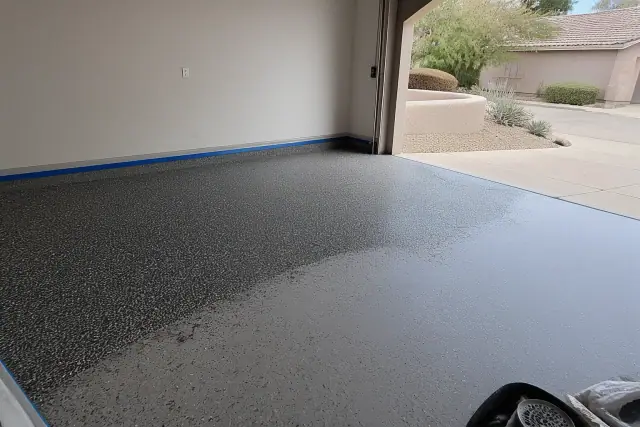
Concrete garage floor prepped with decorative flakes in an empty two-car residential garage in Casas Adobes, AZ.

For one-, two-, and three-car garages, we diamond-grind the slab, repair cracks, and install a solid-color, decorative-flake, or metallic epoxy system. The finished surface is designed for daily vehicle traffic, tool drops, oil exposure, hot tires, and easier cleanup.

Explore Service

Concrete Floor Coatings

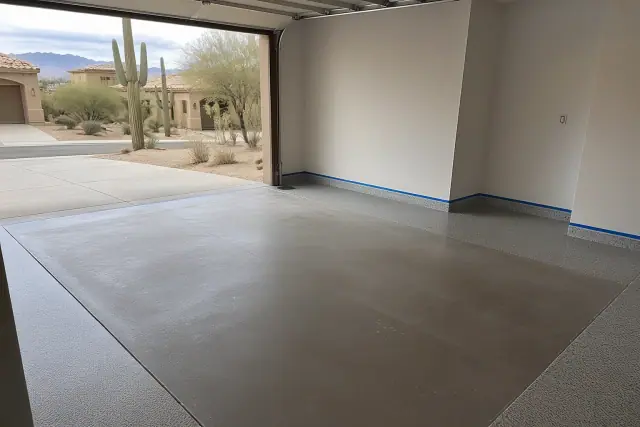
Concrete floor prepped for epoxy coating in a residential garage in Casas Adobes, AZ.

Concrete floor coatings create a nonporous surface that resists stains and prevents untreated concrete from shedding chalky dust. We match the coating build to the slab, property type, expected traffic, and exposure rather than covering defects that need repair first.

Explore Service

Polyaspartic Floor Coatings

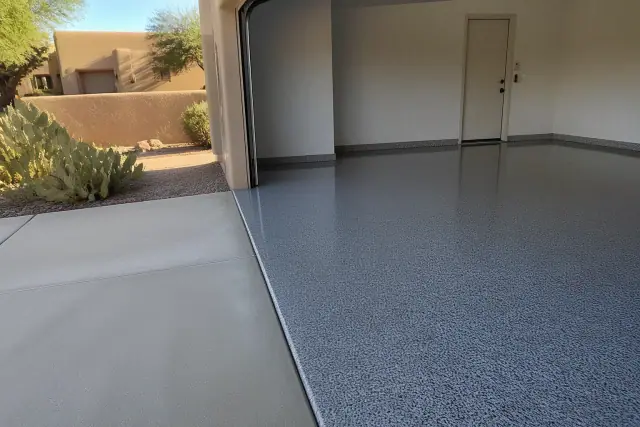
A high-gloss flake polyaspartic floor finish in a residential garage in Casas Adobes, AZ.

Polyaspartic coatings cure in hours rather than days and resist UV yellowing better than standard epoxy. They are a practical choice for sun-exposed patios and garages or commercial floors that cannot remain out of service for a week.

Explore Service

Commercial Epoxy Flooring

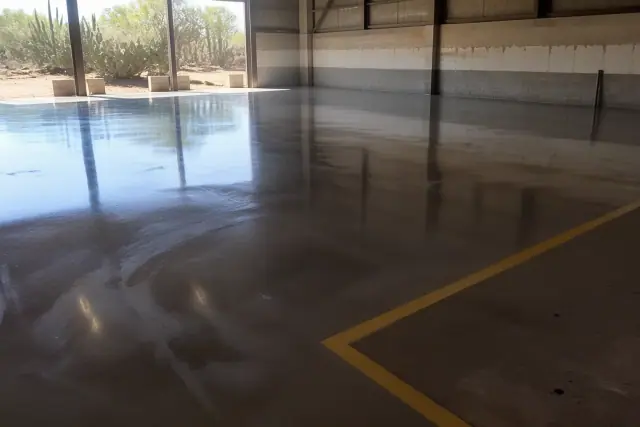
High-gloss epoxy coating on an industrial concrete floor in Casas Adobes, AZ, with visible safety zone markings.

Retail spaces, offices, and showrooms need a professional-looking floor that handles steady foot traffic. When the project allows it, we can schedule installation after hours or over a weekend to reduce disruption to normal operations.

Industrial Epoxy Flooring

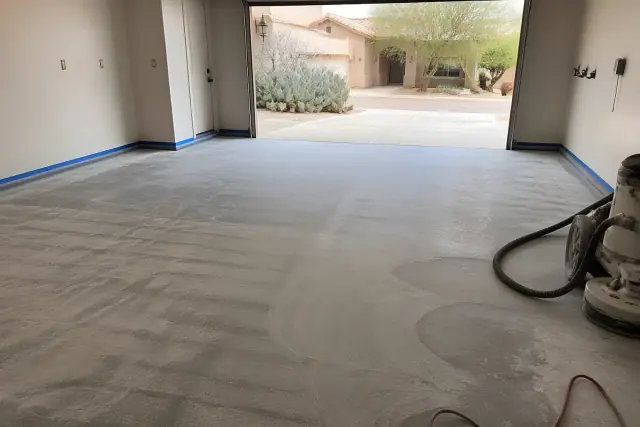
Concrete garage floor prepped with grinding marks and masking tape for epoxy coating in Casas Adobes, AZ.

Warehouses and light-industrial facilities may require higher-mil epoxy builds for forklift traffic, constant abrasion, and chemical exposure. Where the operating conditions call for it, a urethane topcoat adds another layer of chemical and wear resistance.

Flake Epoxy Flooring

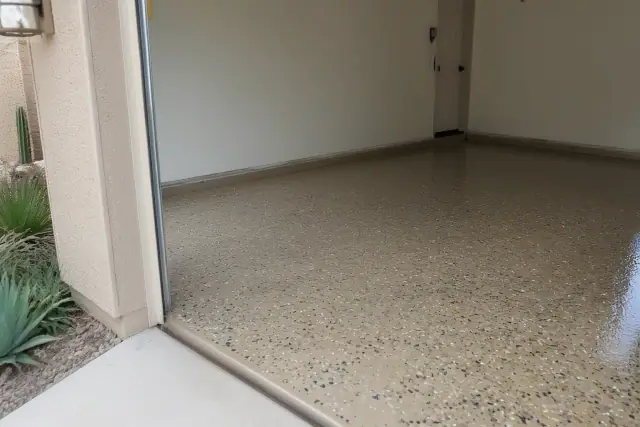
Epoxy flake garage floor with a decorative finish in a residential garage in Casas Adobes, AZ.

Decorative color flake is broadcast into the coating to help disguise dirt, tire marks, and minor surface imperfections. It is our most requested garage finish because it combines a practical stain-resistant surface with a more dimensional appearance than a solid color.

Metallic Epoxy Flooring

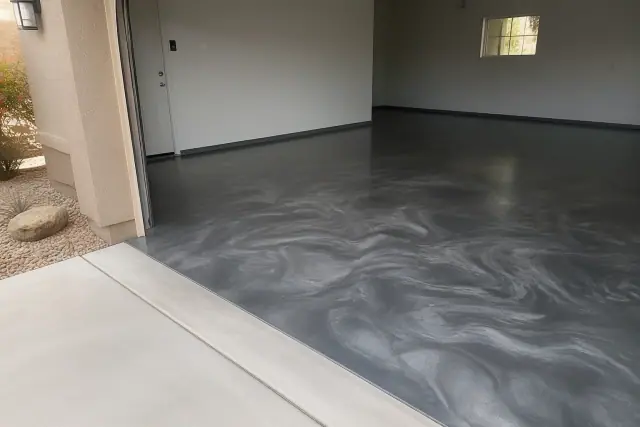
Metallic epoxy garage flooring with a marbled finish in a residential home in Casas Adobes, AZ.

Metallic pigments suspended in epoxy resin create a three-dimensional, marbled finish with natural variation. This option suits showroom garages, entertainment spaces, and custom floors where the appearance should stand apart from a conventional coated slab.

Patio Floor Coatings

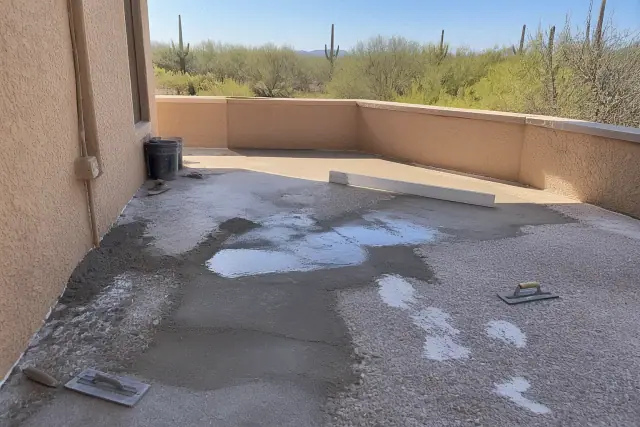
Concrete backyard patio undergoing structural repair and surface leveling in Casas Adobes, AZ.

Patio coatings in Casas Adobes must tolerate direct desert sun without chalking or peeling. UV-stable polyaspartic and epoxy-hybrid systems can provide a slip-resistant, easy-to-clean finish for exposed outdoor living areas.

Pool Deck Coatings

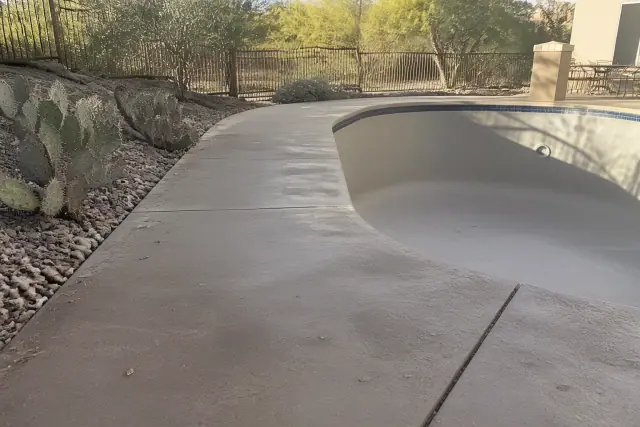
Concrete pool deck awaiting sealant with desert landscaping in Casas Adobes, AZ.

Pool deck systems pair anti-slip texture with cool-touch properties for concrete that becomes uncomfortable by midday. The textured surface improves traction for wet feet while giving the surrounding deck a more finished, cleanable surface.

Concrete Repair & Resurfacing

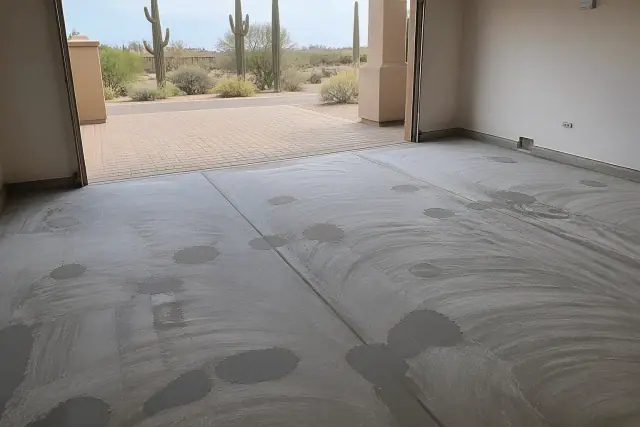
Concrete garage floor prepped for epoxy installation in a Casas Adobes, AZ home with desert landscaping in the background.

Cracks, spalling, pitting, and uneven areas are repaired with polymer-modified materials before a coating is applied. For older paint or failing epoxy, we remove the existing layer to expose hidden moisture or damage, make the needed repairs, and rebuild the floor from bare concrete.

System Selection

How to Choose the Right Coating for Your Floor

The right coating depends on what is happening below, on, and above the concrete. We consider slab age, moisture, sunlight, traffic, chemical exposure, downtime, appearance, traction, and repair needs before recommending epoxy, polyaspartic, or a hybrid build.

Slab Condition and Moisture

Older slabs, fresh concrete, efflorescence, cracks, and past coating failures can each change the preparation plan. Moisture-vapor testing is especially important when slab age or history suggests pressure beneath the coating.

Indoor or Outdoor Exposure

Standard epoxy performs well on protected interior floors, while direct desert sunlight can cause it to yellow. UV-stable polyaspartic or epoxy-hybrid systems are better suited to exposed patios, pool areas, and garages that receive extended sun.

Cure Time and Downtime

Most residential garage projects take one to three days, depending on floor size, repairs, finish, and topcoat choice. A faster-curing polyaspartic build can reduce downtime when the garage or business floor must return to use sooner.

Traffic and Chemical Loads

A home garage exposed to vehicles and tool drops needs a different build than a warehouse handling forklifts, abrasion, and chemical spills. We match resin thickness and topcoat protection to the floor's expected use.

Finish and Slip Resistance

Solid colors offer a simple finish, flake helps conceal dirt and tire marks, and metallic pigments create a marbled look. High-gloss surfaces reflect more overhead light, while satin or matte finishes are more subdued; texture additives improve traction where water or oil may reach the floor.

Budget and Long-Term Value

Installed epoxy flooring generally ranges from $3 to $12 per square foot based on preparation, system, and finish complexity. With proper maintenance, a quality system typically lasts 15 to 20 years, so the itemized quote should account for both the initial build and expected service life.

Casas Adobes Slab Issues

Concrete Problems That Threaten Coatings

Casas Adobes slabs face heat, rapid temperature changes, monsoon moisture, caliche-related drainage concerns, and abrasive desert debris. Preparation must correct surface damage and account for vapor pressure before resin is applied; that difference can separate a coating that lasts 20 years from one that lifts within 18 months.

Request Slab Evaluation

Thermal Cracks and Expansion Joints

Summer slab surfaces regularly exceed 140 degrees, then contract through cooler nights and winter weather. That cycling can create hairline cracks, while existing expansion joints must be honored in the coating layout so movement does not transfer through the finish.

Moisture Vapor and Bubbling

Short, intense monsoon storms and caliche-influenced drainage can move moisture toward a slab. Hydrostatic pressure beneath a poorly bonded coating may cause bubbles or delamination, particularly on older homes built before modern vapor-barrier practices were standard.

Hot Tires and Chemical Stains

Hot-tire pickup can pull at a weak coating bond, while battery acid, oil, transmission fluid, and brake dust can permanently mark bare concrete. A properly bonded resin system and suitable topcoat protect the slab from these common garage exposures.

Caliche Dust and Abrasion

Caliche dust, monsoon grit, and daily traffic work into untreated concrete pores and contribute to a chalky, dusty surface. A nonporous coating keeps debris at the surface, where routine sweeping and mopping are more effective.

Spalling, Pitting, and Uneven Concrete

Surface pitting, loose material, and uneven repairs prevent a coating from laying flat and bonding consistently. We remove unsound concrete, rebuild damaged areas with polymer-modified repair mortar, and resurface where the slab needs a more uniform profile.

Peeling and Surface Failure

Thin DIY resin and acid-etch preparation often leave concrete too closed for a durable mechanical bond, which is why some DIY floors peel within a year or two. Standard epoxy may also yellow in direct sun, and an untextured finish can become slippery when wet, so resin and texture must match the exposure.

Why Choose Us

Why Choose Tucson Epoxy Co. in Casas Adobes?

Professional coating performance depends on judgment before the first coat is mixed. Experience from hundreds of installations across different slab ages and conditions in the Tucson region helps our crews identify efflorescence, moisture concerns, expansion joints, failing layers, and repair needs that a one-size-fits-all approach can miss.

Local Slab Evaluation

Every project begins in person so we can inspect the slab, understand how the floor is used, and check conditions specific to the property. The evaluation supports a written quote based on measured square footage, preparation, coating build, and finish.

Diamond Grinding, Not Acid Etching

Diamond grinding removes laitance and opens the concrete pores more effectively than the acid etch included with many hardware-store kits. We prepare a surface profile consistent with guidance used by the International Concrete Repair Institute so the primer can develop a stronger mechanical bond.

System-Specific Installation

We follow coating-adhesion and concrete-preparation practices consistent with American Society for Testing and Materials guidance, then tailor the primer, decorative layer, and topcoat to the floor. For larger commercial work, we are also familiar with applicable Pima County Development Services permit requirements.

Preparation to Topcoat

Our Floor Coating Process in Casas Adobes

Each installation follows a defined sequence that protects adhesion and makes cure expectations clear. We begin with a free evaluation, prepare and repair the slab, install the selected coating layers, and finish with inspection and guidance for returning the floor to use.

01.

On-Site Slab Evaluation

We inspect the concrete for cracks, spalling, pitting, efflorescence, old coatings, and other signs of moisture or weak material. We also measure square footage and discuss traffic, sunlight, appearance, and downtime before preparing the quote.

02.

Diamond Grinding

Mechanical grinding removes laitance, residual paint, and surface contamination while opening the concrete pores. The resulting profile gives the epoxy primer a sound surface for adhesion.

03.

Crack and Surface Repair

Cracks, spalls, and pits are repaired with polymer-modified patching materials, and uneven areas are resurfaced as needed. Existing expansion joints are identified so the coating layout can accommodate slab movement.

04.

Moisture Testing

We run a moisture-vapor emission test on garage and patio slabs before quoting, with particular attention to slab age and history. Any moisture concern must be addressed before coating so vapor pressure does not undermine the bond.

05.

Coating and Finish Application

A base-coat epoxy primer establishes adhesion, followed by the selected solid color, flake broadcast, or metallic pigment treatment. We then apply an epoxy, polyaspartic, or suitable urethane topcoat for the required abrasion, chemical, and UV resistance.

06.

Final Inspection and Cure Guidance

After the final layer is applied, we inspect the surface and explain the cure window for foot traffic, vehicles, or business use. Following that guidance gives the system time to develop the performance intended for the selected coating build.

Practical Results

Coating Results for Homes & Businesses

Case Study 1: Cleaner residential garages: A nonporous epoxy surface resists oil, brake dust, and caliche debris, while a quick mop handles most spills. High-gloss finishes can also reflect overhead light and make a working garage feel brighter.

Case Study 2: More usable outdoor surfaces: UV-stable patio coatings resist chalking, while textured pool deck systems add traction and cool-touch performance around wet areas. The result is an exterior slab that is easier to clean and more comfortable to use.

Case Study 3: Purpose-built commercial floors: Higher-mil epoxy and suitable topcoats can be configured for showroom foot traffic, warehouse abrasion, forklifts, and chemical exposure. Scheduling options can also reduce disruption for an operating business.

Start With the Slab

Request a Free
On-Site
Evaluation

Tell us how the floor is used, what condition it is in, and which finish you are considering. Tucson Epoxy Co. will evaluate the slab, measure the project, identify preparation needs, and provide a written, itemized quote before work begins.

Epoxy Flooring Help

FAQs About Epoxy Flooring in Casas Adobes, AZ

These answers cover pricing, preparation, coating choices, timelines, and local slab conditions. For advice tied to your concrete and intended use, request an on-site evaluation.

Call Our Epoxy Team

A standard two-car garage system typically costs $2,000 to $4,500. Premium polyaspartic finishes commonly range from $4,500 to $7,000, with the final price shaped by garage size, slab repairs, moisture conditions, and the selected finish.

A 20x20 floor covers 400 square feet and typically costs $1,200 to $4,800 at the supported installed range. A basic single-color system trends lower, while extensive repair, decorative flake, metallic effects, or a polyaspartic topcoat can move the project higher.

Installed epoxy flooring generally ranges from $3 to $12 per square foot. Surface preparation, crack repair, moisture mitigation, coating thickness, decorative finish, and topcoat material all affect where a project falls within that range.

Epoxy can be slippery when wet unless texture is added, and standard epoxy may yellow under direct UV exposure. It also depends on thorough grinding and moisture evaluation; poor preparation can lead to peeling, bubbles, or delamination, and later removal requires grinding.

Most garage systems use a minimum of two coats: an epoxy primer or base coat for adhesion and a protective topcoat. Flake and metallic floors include a decorative layer between them, creating an effective three-layer system, and some high-traffic floors receive an additional topcoat.

A quality epoxy system typically lasts 15 to 20 years with proper preparation and maintenance. Slab moisture, traffic, chemical exposure, UV exposure, coating build, and how the floor is cared for all influence service life.

Polyaspartic material cures faster and offers stronger resistance to UV yellowing, so it is useful for sun-exposed floors and projects with limited downtime. It can also be applied across a wider temperature range, but its material cost per square foot is generally higher than standard epoxy.

Most residential garage projects take one to three days. Floor size, crack or moisture repairs, decorative layers, and the topcoat determine the schedule, and the crew provides cure guidance before vehicles return.

Monsoon moisture and caliche-influenced drainage can contribute to vapor movement beneath concrete. A moisture-vapor emission test helps identify conditions that could push through a weak coating bond and cause bubbling or delamination.

We diamond-grind the slab to remove laitance and open the pores, then repair cracks, spalls, and pitting with polymer-modified materials. Moisture concerns and old coatings are addressed before the epoxy primer is applied.

Solid color provides a simple appearance, flake helps hide dirt and tire marks, and metallic pigment creates a marbled custom look. Gloss can brighten a garage by reflecting light, while satin or matte is more subdued; texture can be added where traction matters.

Yes, when the resin system is selected for UV and weather exposure. Tucson Epoxy Co. uses UV-stable polyaspartic and epoxy-hybrid options for patios, while pool deck systems add anti-slip texture and cool-touch properties.

Yes. We strip the failing paint or coating to bare concrete, inspect for hidden cracks or moisture, complete the needed repairs, and install a new system on the prepared slab.

We serve properties throughout Casas Adobes, including areas near Ina Road, Skyline Drive, Cortaro Road, Casas Adobes Plaza, Foothills Mall, and the Cañada del Oro wash. Coverage also extends to Oro Valley, Catalina Foothills, Marana, central Tucson, and Pima County, including Sahuarita and Vail for larger commercial and industrial projects.

We assess slab condition, look for moisture and repair needs, measure square footage, and discuss traffic, sunlight, downtime, and finish preferences. After the evaluation, we provide a written, itemized quote and explain the proposed coating build before work begins.