Proudly serving Tucson, Oro Valley, Marana, Vail, Sahuarita, Green Valley & surrounding areasCall or Text 24/7: +1 (520) 567-9887

Industrial Epoxy Flooring and Heavy-Duty Concrete Systems in Tucson, AZ

Tucson Epoxy Co. installs industrial and commercial epoxy flooring for facilities and property owners across Tucson. We match 100% solids epoxy systems, moisture-mitigating primers, and polyaspartic topcoats to the slab conditions found on-site. Our work also includes flake and metallic finishes, garage and patio floor coatings, pool deck coatings, and concrete repair resurfacing. Each project starts with surface preparation designed for a strong mechanical bond.

Unshaded Tucson slabs can push past 140 degrees, while abrasive Sonoran Desert dust adds wear under daily traffic. Monsoon-season humidity spikes from July through September can also drive moisture vapor through porous concrete. A coating that ignores heat, moisture, chemical exposure, or vehicle loads can blister, delaminate, or wear prematurely. We evaluate those conditions before selecting the primer, build coat, aggregate, and topcoat.

Our crews test moisture vapor emission per ASTM F2170 and evaluate bond potential before materials go down. Surface preparation follows SSPC-SP13/NACE 6 concrete standards with diamond grinding or shot blasting rather than acid etching.

Tucson Epoxy Co. installs industrial epoxy flooring throughout Tucson, Oro Valley, Marana, Sahuarita, Vail, and the greater Pima County metro area.

★ ★ ★ ★ ★4.9/5 Average Rating · 20+ Years of Experience · Thousands of Customers Helped · Licensed & Insured · Residential & Commercial

Industrial Epoxy Flooring Options

What Is Industrial Epoxy Flooring?

Industrial epoxy flooring is a bonded coating assembly that turns a prepared concrete slab into a seamless working surface. Primer, build coats, broadcast aggregate, and a protective topcoat can be combined to match traffic, chemicals, cleaning needs, and appearance.

Working floors may need resistance to forklifts, pallet jacks, steel-wheeled carts, solvents, hydraulic fluid, or cleaning chemicals. The correct assembly depends on the actual exposure rather than a generic garage-grade formula.

Heavy-duty systems can be built to 20-30 mils or thicker to distribute point loads from machinery and racking. That build is paired with the appropriate chemical-resistant, slip-resistant, or UV-resistant finish for the space.

Benefits of Industrial Epoxy Flooring

A properly specified coating protects the slab while making the floor easier to clean, safer to navigate, and better suited to the facility's daily work. The benefit comes from matching preparation, material, thickness, aggregate, and topcoat to the environment.

  • Resists abrasion from forklifts, pallet jacks, and carts
  • Protects against specified solvents, acids, oils, and hydraulic fluid
  • Eliminates grout lines and seams that collect dust and residue
  • Accepts aluminum oxide or silica grit for added slip resistance
  • Resurfaces damaged concrete without a full slab replacement
  • Supports flake blends, custom colors, and metallic finishes
  • Uses polyaspartic topcoats where stronger UV stability is needed
  • Allows fast mop-and-go cleaning with prompt spill removal
Epoxy Flooring Services

Industrial Epoxy Flooring Services

Projects range from single-day polyaspartic garage refreshes to multi-thousand-square-foot warehouse floors with heavy-duty broadcast systems. We use the slab condition, traffic load, chemical exposure, downtime, and finish goals to shape the work.

Industrial Epoxy Flooring

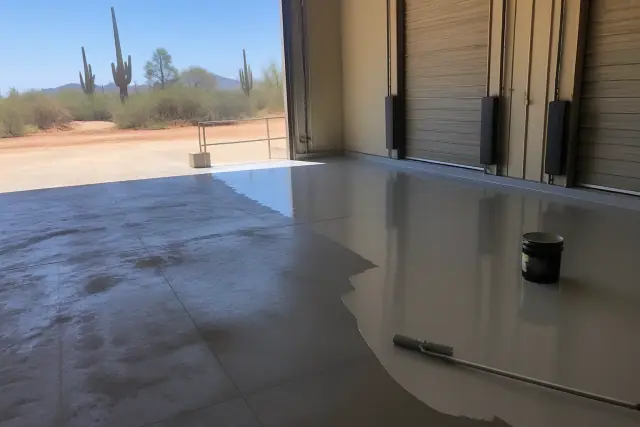
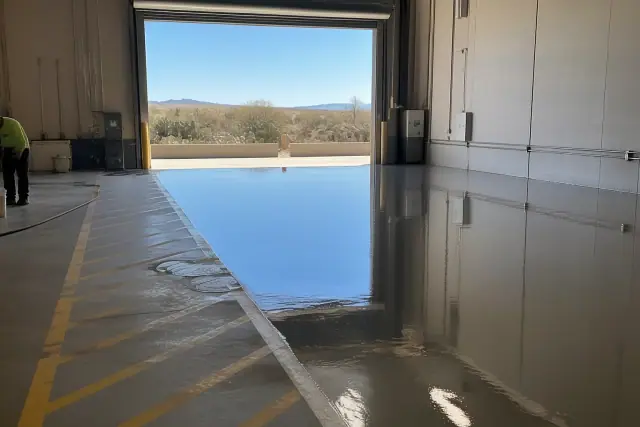
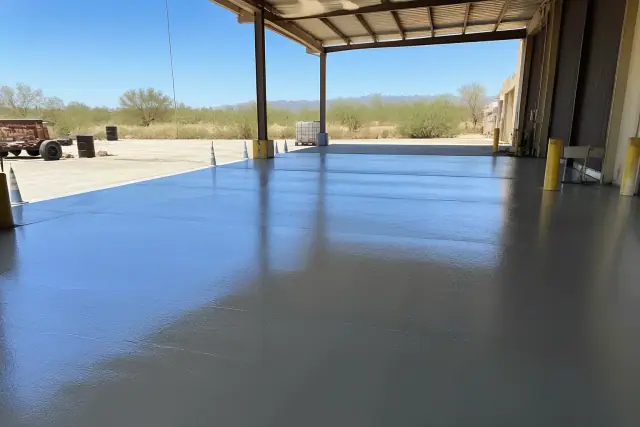
Half-applied industrial epoxy flooring on a warehouse loading dock in Tucson, AZ, with saguaro cacti in the background.

Warehouses and manufacturing plants can receive high-build epoxy designed around racking, forklifts, steel-wheeled equipment, and chemical exposure. In high-traffic applications, industrial floors typically run 8 to 10 years before recoating is needed, with actual life depending on use and maintenance.

Request Estimate

Commercial Epoxy Flooring

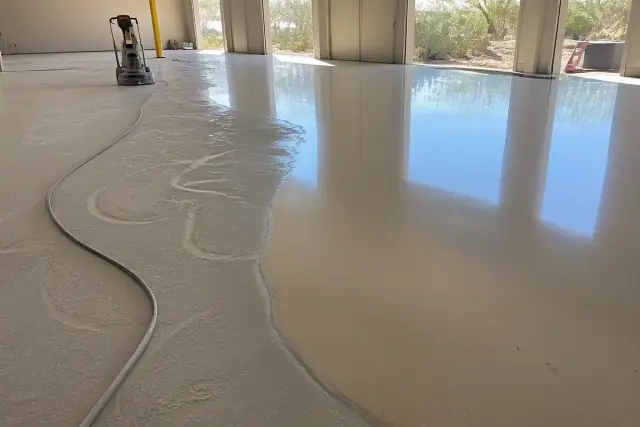
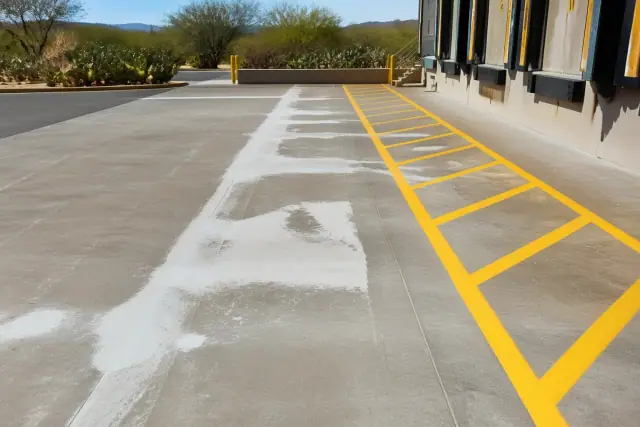
Industrial concrete floor with epoxy coating, sanding residue, and desert landscape in Tucson, AZ.

Commercial floors can combine daily wear protection with a finished appearance for retail areas, offices, showrooms, lobbies, and food-adjacent spaces. Seamless surfaces speed routine cleaning, while aggregate and finish choices address water, oil, and foot-traffic exposure.

Request Estimate

Garage Floor Epoxy

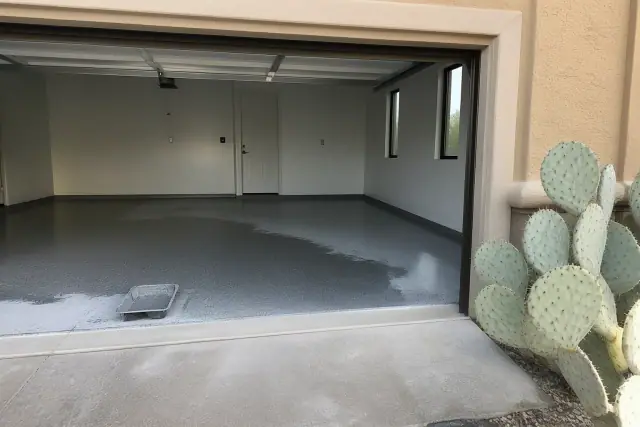
Freshly applied high-gloss epoxy base coat on a residential garage floor in Tucson, AZ with cacti visible outside.

Garage floor epoxy seals dusty concrete and can be finished with flake broadcast, custom color, or a fast-curing polyaspartic topcoat. Industry pricing for a standard two-car garage often falls between $4,000 and $5,500 installed, depending on preparation, system, and design.

Request Estimate

Polyaspartic Floor Coatings

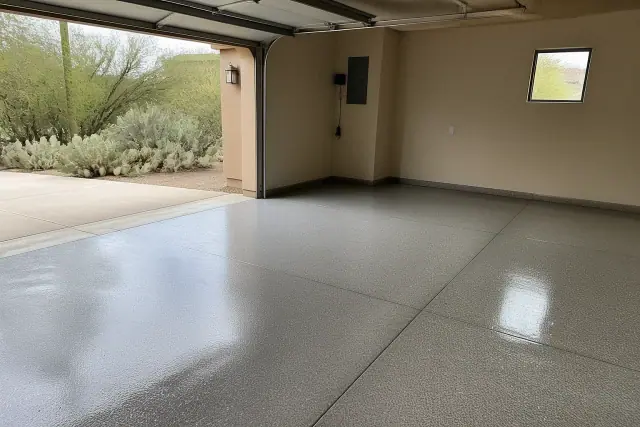
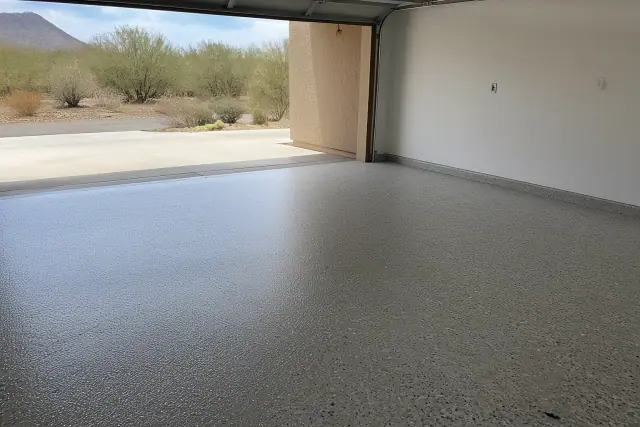
Finished polyaspartic floor coating in a residential garage with desert views in Tucson, AZ.

Polyaspartic coatings are a fast-curing alternative for garages, patios, and pool decks where downtime and direct sun matter. Traditional epoxy may need 24 to 72 hours between coats, while many residential polyaspartic installations can finish in one day with vehicle traffic possible the next day.

Request Estimate

Metallic & Flake Epoxy Flooring

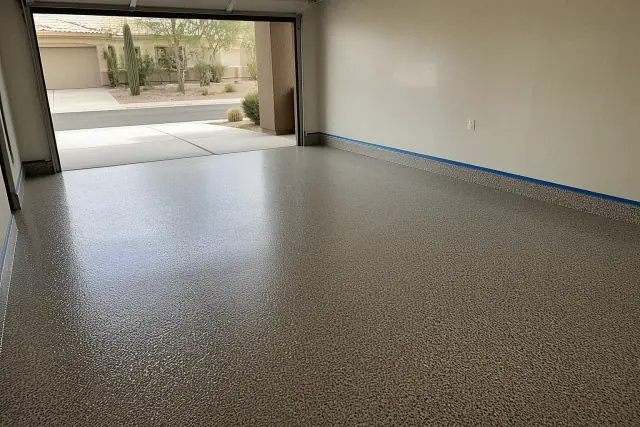
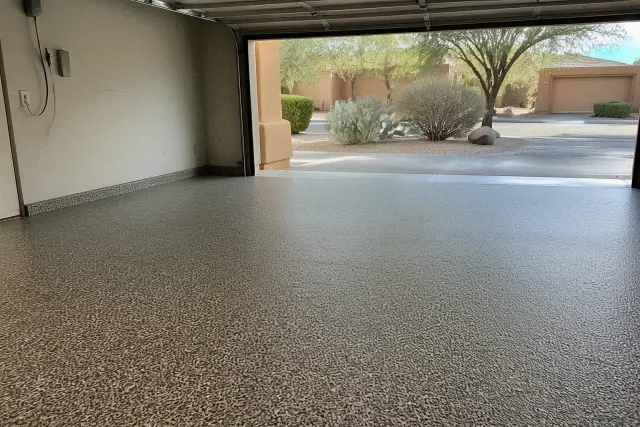
Freshly applied metallic flake epoxy flooring in a residential two-car garage in Tucson, AZ.

Decorative floors can use broadcast flake, custom color blends, logo inlays, or hand-manipulated metallic pigments. Metallic finishes create one-of-a-kind movement and depth for showrooms, custom garages, and high-end residential spaces.

Request Estimate

Concrete Repair & Resurfacing

Industrial concrete warehouse floor undergoing repair and resurfacing for epoxy coating in Tucson, AZ.

Cracking, spalling, pitting, and efflorescence are assessed before coating begins. Polymer-modified overlays and epoxy mortars can rebuild damaged areas, creating a sound base for a waterproof epoxy coating or polyaspartic sealer.

Request Estimate
Coating System Options

Types of Epoxy Floor Systems

The right system is a combination of preparation, primer, build coat, aggregate, and topcoat rather than a single product choice. These options address different levels of load, chemicals, UV exposure, downtime, and visual finish.

100% solids epoxy coating leveling on an industrial warehouse concrete floor in Tucson, AZ.

100% Solids Epoxy

A 100% solids epoxy primer and build coat provides the thickness and durability needed for many industrial and commercial floors. It offers a stronger foundation than thin water-based formulas when paired with mechanical surface preparation.

  • High-build coverage for demanding traffic
  • Strong mechanical bond over diamond-ground concrete
  • Broadcast or trowel-down application options
  • Greater build than water-based or solvent-based formulas
  • Can receive polyaspartic or urethane topcoats
Request Estimate
Polyaspartic topcoat being applied to an empty residential garage floor in Tucson, AZ.

Polyaspartic Topcoats

Polyaspartic topcoats add faster cure, UV resistance, and flexibility to floors exposed to sun or daily temperature movement. They are especially useful for garages, patios, and pool decks where standard epoxy may yellow or chalk.

  • Foot traffic can be possible within hours
  • Vehicle traffic can be possible within a day
  • Resists color and gloss breakdown from direct sun
  • Handles thermal expansion better than rigid epoxy alone
  • Protects flake, metallic, and solid-color finishes
Request Estimate
Novolac chemical-resistant epoxy flooring installation on a warehouse loading dock in Tucson, AZ.

Novolac Chemical-Resistant Epoxy

Novolac epoxy is designed for facilities with more aggressive chemical exposure than a general-purpose floor can handle. The system should be specified against the actual acids, solvents, hydraulic fluid, or cleaning chemicals used in the space.

  • Broader acid and solvent resistance
  • Suited to machine-shop and manufacturing exposure
  • Specified for the chemicals present on-site
  • Compatible with heavy-duty build coats
  • Supports prompt spill cleanup and routine maintenance
Request Estimate
Multi-colored flake epoxy flooring in an empty two-car residential garage in Tucson, AZ.

Flake Epoxy Flooring

Flake epoxy uses a broadcast blend to add color, texture, and visual variation across the floor. It is a practical choice for garages, showrooms, retail areas, and other spaces that need durability with a more finished appearance.

  • Custom color-blend options
  • Textured visual finish
  • Suitable for garages and commercial interiors
  • Can be sealed beneath a polyaspartic topcoat
  • Balances utility with a professional appearance
Request Estimate
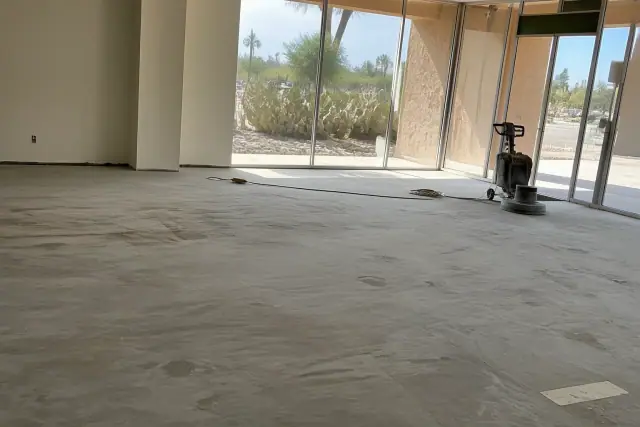
Concrete floor prepared for metallic epoxy installation in a Tucson, AZ retail showroom with desert views.

Metallic Epoxy Flooring

Metallic pigments are hand-manipulated while the epoxy is wet, creating depth and color movement that does not repeat exactly from floor to floor. A polyaspartic or urethane topcoat protects the glass-like finish from stains and traffic.

  • One-of-a-kind pigment movement
  • Three-dimensional, liquid-like depth
  • Custom palette coordination
  • Resistance to oil, tire marks, and foot traffic
  • Routine dust-mop care without wax or periodic resealing
Request Estimate
Finding Your Right Fit

Choosing the Right Epoxy Flooring Approach

The best approach depends on slab moisture, existing coating failure, cracks, traffic type, point loads, chemical exposure, slip-resistance needs, UV exposure, and allowable downtime. We use those conditions to choose preparation, repairs, coating thickness, aggregate, and the final topcoat.

Moisture and Bond Testing

Moisture vapor emission and bond potential are checked before the coating is selected. That assessment helps identify when a moisture-mitigating primer or additional repair work belongs in the system.

Traffic-Matched Coating Design

A warehouse with steel-wheeled carts needs a different build than a showroom or residential garage. Primer, build thickness, broadcast material, and topcoat are matched to load, chemicals, cleaning, sun, and appearance.

Measured Finish Quality

Coating thickness is inspected with a wet film gauge, and the finished surface is checked for pinholing or fisheyes. Slip resistance is confirmed against ANSI/NFSI B101.1 coefficient-of-friction guidance for the way the space will be used.

What Sets Us Apart

Why Choose Us for Industrial Epoxy Flooring Installation?

Tucson Epoxy Co. bases the specification on the slab and the work performed above it, not on a one-size-fits-all kit. Mechanical preparation, condition-matched materials, and final inspection work together to reduce avoidable coating failure and give the facility a practical maintenance plan.

Request a Slab Assessment

Hot-Slab Thermal Cycling

Tucson sits in the Sonoran Desert, 108 miles southeast of Phoenix, and summer facilities can see a daily temperature swing of 30 degrees or more between night and afternoon. Repeated expansion and contraction stresses rigid coatings, especially on exposed concrete.

Moisture Vapor and Blistering

Seasonal humidity can push moisture vapor through porous concrete. Without testing and the right vapor-mitigation approach, trapped moisture can create blisters, bubbles, and delamination beneath the coating.

Forklift Abrasion and Concrete Dust

Forklifts, pallet jacks, and steel-wheeled carts can grind an unprotected slab into dust. Under heavy use, bare concrete can degrade within a few years, leaving pitting, debris, and a harder-to-clean workspace.

Chemical and Oil Exposure

Solvents, acids, hydraulic fluid, oil, and cleaning chemicals can stain or attack an underspecified floor. Facilities near the Port of Tucson rail yard and South Tucson's manufacturing zone need resistance selected for the specific exposure.

UV Yellowing and Chalking

Standard epoxy can yellow and chalk under prolonged direct sun. Patio floor coatings and pool deck coatings benefit from a UV-resistant polyaspartic topcoat that holds color and gloss longer.

Cracks, Spalling, and Efflorescence

Pima County's caliche soil layer and seasonal ground movement contribute to slab cracking. Cracks, control joints, spalling, pitting, and efflorescence must be assessed and repaired appropriately instead of being hidden beneath a cosmetic coat.

How It Works

Our Industrial Epoxy Flooring Process

Every project starts with an honest look at what is happening inside and on top of the concrete. The six-step process connects slab assessment, mechanical preparation, repairs, material application, and quality checks to the facility's actual operating needs.

01.

Inspect the Slab and Work Area

We review the concrete, existing coatings, cracks, joints, pitting, and signs of adhesion failure. Traffic, chemicals, cleaning practices, sun exposure, desired finish, and allowable downtime are documented before a system is proposed.

02.

Test Moisture and Bond Potential

The slab is checked for moisture vapor emission and the ability to form a mechanical bond. Results guide the use of moisture-mitigating primer and help prevent avoidable blistering or delamination.

03.

Mechanically Prepare the Surface

Diamond grinding or shot blasting removes weak surface material and opens the concrete pores for adhesion. This mechanical approach provides the profile a coating needs without relying on acid etching.

04.

Repair Cracks and Damaged Concrete

Cracks and control joints are addressed before primer. Spalled or pitted areas can be rebuilt with polymer-modified overlays or epoxy mortars so the coating begins on a sound, even base.

05.

Apply the Coating System

The application may include epoxy primer, broadcast or trowel-down build coats, and a polyaspartic or urethane topcoat. High-build industrial systems can require 2-3 days of cure time between coats, depending on the assembly.

06.

Inspect the Finished Floor

Before the job site is released, we verify coating thickness and inspect for pinholing, fisheyes, and finish consistency. Slip resistance is checked for the intended use, and return-to-service timing is explained for the installed system.

Plan Your Floor

Schedule an Industrial Epoxy Flooring Consultation

Tucson Epoxy Co. walks each facility before quoting so the estimate reflects slab condition, preparation, repairs, system build, and operating needs. Request an assessment to compare a coating plan based on your actual concrete rather than a generic per-square-foot assumption.

Epoxy Flooring Help

Industrial Epoxy Flooring FAQs

These answers cover common questions about industrial and commercial epoxy pricing, durability, preparation, cure time, repairs, and maintenance in Tucson.

Call Our Experts

Industrial and commercial epoxy flooring installation typically runs $7 to $15 per square foot. Surface preparation, coating thickness, chemical resistance, moisture mitigation, and crack repair affect the final price; a 10,000 square foot warehouse with heavy-duty specifications can run well into six figures.

Standard epoxy can yellow or chalk under prolonged UV exposure, and traditional systems can create downtime while coats cure. Improper preparation can also lead to blistering or delamination, which is why sun exposure, moisture, and mechanical surface preparation must be addressed before installation.

100% solids epoxy provides high build and strong durability for many high-traffic industrial and commercial floors. Novolac epoxy offers broader resistance where aggressive acids and solvents are present, while a polyaspartic or urethane topcoat can add flexibility or UV stability to the assembly.

A 20x20 garage is roughly 400 square feet. At typical residential installed pricing of $5 to $9 per square foot, the total generally falls between $2,000 and $3,600; industry figures place materials around $2 to $6 per square foot and labor around $4 to $9 per square foot, depending on preparation and design.

A 1,000 square foot space typically costs between $3,000 and $10,000 or more, averaging around $3 to $10 per square foot depending on the system and preparation. High-build functional commercial or industrial work tends to run $3 to $6 per square foot, while a full seal coat system can add another $2 to $5 per square foot; decorative flake or metallic finishes can move the total toward the upper end.

A straightforward coating over an existing slab generally does not require a separate permit from the City of Tucson Development Services Department or Pima County Development Services because it is a surface finish. Structural concrete repair, slab replacement, or work tied to a larger commercial renovation may require permitting, so requirements are confirmed with the relevant jurisdiction when the scope goes beyond surface coating.

High-traffic industrial epoxy floors typically last 8 to 10 years before recoating is needed, while lighter-use commercial and residential floors can exceed two decades with routine maintenance. Traffic type, chemical exposure, preparation, moisture testing, prompt spill cleanup, and the installed system all affect service life.

Diamond grinding or shot blasting opens the concrete pores and creates the profile needed for a mechanical bond. Thin big-box kits installed without that preparation can peel within a year or two on hot Tucson slabs, while acid etching does not provide the same controlled profile.

Return-to-service time depends on the selected assembly. High-build epoxy may require multiple cure periods, while polyaspartic topcoats can allow foot traffic in hours and vehicle traffic within a day; the installed system's specific timing should be followed.

Yes. Aluminum oxide or silica grit can be broadcast into the topcoat for areas exposed to water, oil, or frequent foot traffic, with the amount and texture matched to how the space is used and cleaned.

A polyaspartic topcoat is the preferred option for sun-exposed concrete because it resists UV-related yellowing and chalking better than standard epoxy. Its added flexibility also helps with daily thermal expansion and contraction on patios and pool decks.

Yes. Cracks, control joints, spalling, pitting, and efflorescence are assessed first, and damaged areas can be rebuilt with polymer-modified overlays or epoxy mortars before primer and topcoat are applied. Resurfacing typically costs a fraction of full slab replacement and can return a facility to operation in days instead of the weeks required for tear-out and repour.

Routine dust mopping and regular cleaning keep abrasive grit from building up on the surface. Chemical spills should be cleaned promptly, and high-load or chemically aggressive areas should be monitored so recoating can be planned before wear reaches the concrete.