10-15 Mil Garage Target
A standard two-car garage in Tucson commonly calls for a 15-mil system. Storage-focused garages may perform at 8-10 mils, while daily traffic, tool carts, and workshop use can justify 15-20 mils.
Tucson Epoxy Co. generally targets 10-15 mils of dry film thickness for a standard residential garage or patio in Tucson. The right polyaspartic build can range from 5 mils to roughly 40 mils as slab condition, traffic, chemical exposure, and the number of system layers change.
A standard two-car garage in Tucson commonly calls for a 15-mil system. Storage-focused garages may perform at 8-10 mils, while daily traffic, tool carts, and workshop use can justify 15-20 mils.
A basecoat, full flake or quartz broadcast, and clear topcoat can total 20-40 mils. That heavier buildup suits commercial kitchens, retail floors, and industrial bays exposed to abrasion, forklifts, or chemicals.
Ask bids to state the cured dry mil specification and the planned layers. During application, a 6-8 mil wet reading, a gauge rake, and consistent microfiber back-rolling help control each pass and prevent lap marks.
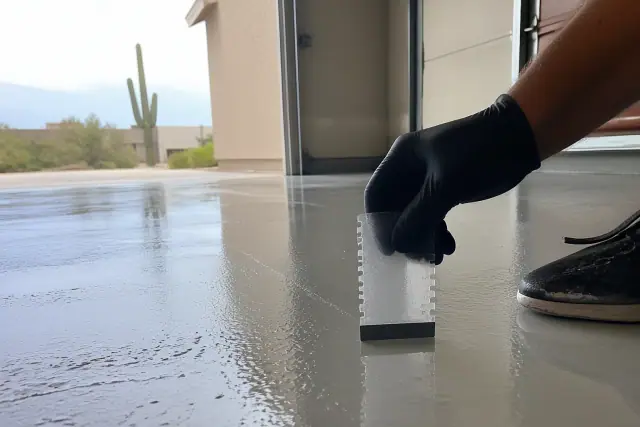
A wet mil gauge checking a fresh 6-8 mil pass beside a gauge rake and microfiber roller. The scene should make consistent application and a continuous wet edge easy to understand.
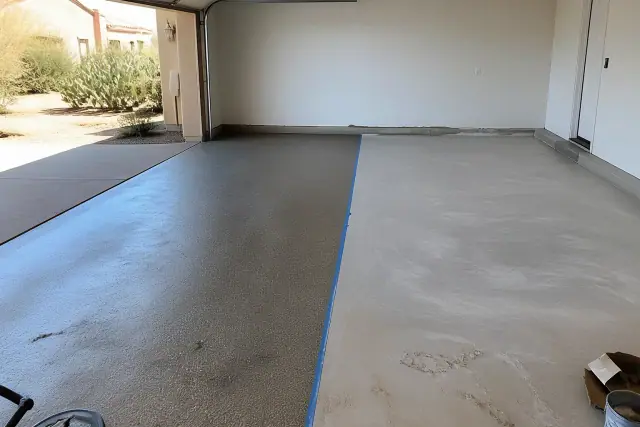
A cutaway comparison between a 4-8 mil single roll-on film and a layered 15-mil garage system with basecoat, full flake broadcast, and topcoat. The contrast should emphasize total cured buildup rather than container size.
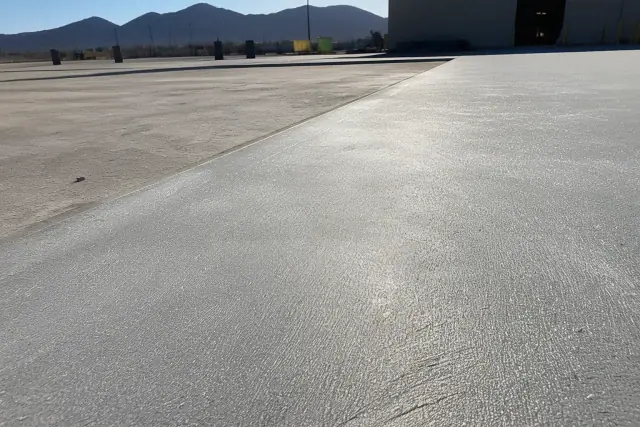
A clean diamond-ground slab with an ICRI CSP-3 surface profile, repaired cracks, and coating keyed into the concrete. This illustrates why preparation helps prevent thin spots, pinholes, and premature delamination.
Typical of light-duty DIY kits and low-traffic spaces. Under regular vehicle traffic, this thinner film can show wear within a couple of years.
The usual professional target for a standard residential garage or patio. It balances polyaspartic's fast cure with resistance to tire shear, hot-tire pickup, and monsoon grit.
A useful range for high-traffic garages and light commercial floors. The added build supports frequent vehicles, workshop activity, and higher abrasion loads.
Reserved for demanding commercial or industrial floors with full flake or quartz broadcast. Forklift traffic, chemical exposure, and slip-resistance needs can justify this heavier total system.
| Dry Film Thickness | Typical Fit | Practical Meaning |
|---|---|---|
| 4-8 mils | Light-duty DIY or low traffic | A thin film that can wear faster under regular vehicle traffic. |
| 10-15 mils | Standard residential garage or patio | The common professional target for balanced wear resistance. |
| 15-20 mils | High-traffic garage or light commercial use | More buildup for abrasion, tool carts, and frequent traffic. |
| 20-40 mils | Commercial or industrial broadcast system | A heavy flake or quartz system built for demanding use. |
Wet mil thickness is measured while the coating is being applied; dry mil thickness is the cured film that resists abrasion, tire shear, and chemicals. Because polyaspartic has high solids content, wet-to-dry shrinkage is relatively small, but the final specification should still be stated as dry film thickness.
Cracked, pitted, or previously coated concrete needs repair and resurfacing before the coating build can be controlled. Tucson's expansive clay and caliche soils can contribute to slab movement, and hairline cracks are common in homes built before the 1990s, sometimes requiring flexible polyurea crack filler. Squeegee-and-roll application can produce an even 8-15 mil film, while inconsistent pressure or a lost wet edge creates thin spots, lap lines, and uneven buildup.
How fast does polyaspartic cure? A coat can be walk-on ready in 30-45 minutes, but preparing and coating a two-car garage takes longer than 2 hours and often fills a full day; vehicle traffic may resume the same day or by the next morning. How does it compare with epoxy? Polyaspartic generally runs 5-20 mils per coat, while epoxy commonly runs 10-20 mils and can build to 3/8 inch in heavy industrial work; epoxy may also need 24-72 hours between coats. What about coverage and cost? Polyaspartic covers roughly 125 square feet per gallon over flake broadcast versus about 160 square feet per gallon for a 10-mil epoxy basecoat, and Tucson pricing typically ranges from $4-$12 per square foot or $1,800-$6,900 for a standard two-car garage, depending on preparation, flake density, and mil buildup.
Share the slab condition, traffic level, chemical exposure, and intended use to compare an appropriate dry mil specification. A local coating team can inspect preparation needs and explain the basecoat, broadcast, and topcoat included in the proposed system.